Can't Forget the Crash. Can't Remember Your Lines.
Same hormone. Same system. Opposite effects. Cortisol burns in the traumatic memories you can't shake and locks you out of the information you need most.

Justin Angeles
· 4 min read
You can probably remember exactly where you were on the worst day of your life. What you were wearing. What the air smelled like. Details you'd never remember from a normal Tuesday.
But you've also gone completely blank during a presentation you prepared for all week. The information was there. You knew it. And under pressure, your brain locked you out of it.
Same hormone. Same system. Opposite results.
The Paradox
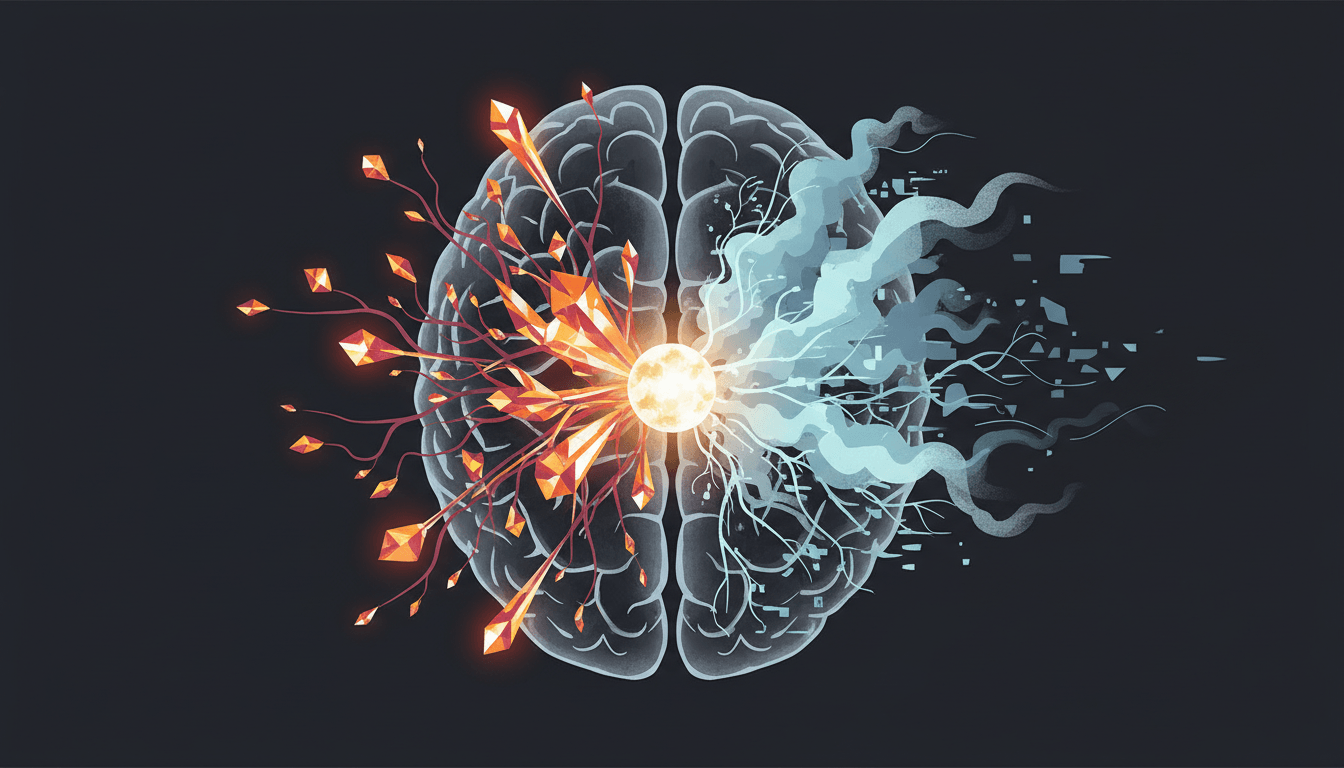
Cortisol is your primary stress hormone. It floods your system during threatening or emotionally intense events. And it does two contradictory things to memory.
During the event: Cortisol enhances memory consolidation. When stress hormones are elevated at the time something happens, the memory gets stamped "important" and stored with extra detail. Traumatic memories are often vivid, intrusive, and hard to shake because the stress response literally strengthened the encoding.
After the event: Cortisol impairs memory retrieval. When stress hormones are elevated at the time you're trying to recall something, you can't access what you already know. You blank on a test you studied for. Forget your lines on stage. Can't remember someone's name when you're anxious.
Same chemical. Different timing. Opposite effects.
The Data
Sonia Lupien at the University of Montreal has been tracking this for decades. In a longitudinal study, her team measured cortisol levels in healthy older adults annually and found three distinct patterns.
The group whose cortisol climbed year over year and stayed high showed the worst memory performance at follow-up. The group whose cortisol climbed but leveled off at moderate levels did better. The group whose cortisol dropped over time? Memory stayed sharpest.
The pattern was clear. Chronically elevated cortisol eats memory. Not acutely. Not the one bad week. Chronically. Year after year of elevated stress wears down the hippocampus.
Lupien also found that working memory is more sensitive to cortisol than declarative memory. Which means stress doesn't just mess with your ability to recall facts. It hits your ability to hold and manipulate information in real time. The working memory you need for problem-solving, conversation, and reasoning goes first.
Why Emotional Memories Hit Different
There's another layer. The amygdala works with the hippocampus to prioritize emotional memories. And the mechanism is now measurable at the level of individual neurons.
A recent study using intracranial recordings in human patients found that successful emotional memory encoding depends on precise timing between the two structures. The amygdala generates a theta rhythm (a slow, regular oscillation). The hippocampus generates gamma bursts (fast, high-frequency activity). When the hippocampal gamma fires at the right phase of the amygdala theta, the emotional memory locks in.
The amygdala says "this matters" by setting up a rhythmic pattern. The hippocampus fires its encoding signal at exactly the right moment. Memories that land in the phase window get priority storage. Memories that miss it don't.
When researchers applied inhibitory electrical stimulation to disrupt this coordination, the enhancement for emotional memories disappeared. The patients still formed neutral memories normally. But the emotional boost, the thing that makes fear memories and trauma memories so persistent, was specifically eliminated.
The Chronic Problem
Acute stress actually serves the memory system. A car accident, a presentation, a confrontation. It sharpens encoding for important events. Adaptive. You want to remember the dangerous thing so you can avoid it next time.
Chronic stress breaks it. When cortisol stays elevated day after day, the hippocampus (which is loaded with cortisol receptors) starts to suffer. Dendritic branches retract. Neurogenesis slows. The structure physically shrinks.
This is what Lupien's longitudinal data shows. It's not that stress is bad for memory. It's that sustained stress is bad for memory. The system that evolved to help you remember a predator doesn't work well when the predator is your inbox and it never goes away.
What I Take From This
I've noticed the pattern in my own life. During my worst periods, when stress was constant and not episodic, my memory was terrible. I'd forget conversations from the same day. Walk into rooms with no idea why. Lose track of what I was saying mid-sentence.
At the time, I thought something was wrong with me. Now I think my hippocampus was just drowning in cortisol.
The flip side is real too. The memories from those periods that were emotionally intense? Crystal clear. I can tell you exactly what was said during the worst fight. Exactly what the room looked like during the scariest moment. The stress made those memories indelible while making everything else dissolve.
That's the paradox in action. Cortisol is a spotlight. It illuminates what's in the beam and plunges everything else into darkness. The problem isn't the spotlight. It's when you can't turn it off.
Sources
- Lupien, S.J. et al. "Stress hormones and human memory function across the lifespan." Psychoneuroendocrinology (2005) (opens in new tab)
- Tompary, A. & Bhatt, S. "Neuronal activity in the human amygdala and hippocampus enhances emotional memory encoding." Nature Communications (2024) (opens in new tab)
- Aversive memory formation in humans involves an amygdala-hippocampus phase code. Nature Communications (2022) (opens in new tab)
- Peavy et al. "Effects of Chronic Stress on Memory Decline." American Journal of Psychiatry (2009) (opens in new tab)
- Lupien, S.J. et al. "Effects of stress hormones on the brain and cognition." PMC (2017) (opens in new tab)
Part of the Rewrite series. Previous: Every Night, Your Brain Decides What You Get to Keep. Next: Why You Can't Remember Being Three.