Your Mitochondria Have a Light Switch
Red light therapy works because a specific enzyme in your mitochondria absorbs photons and releases the molecule that's been choking your cellular energy production.

Justin Angeles
· 4 min read
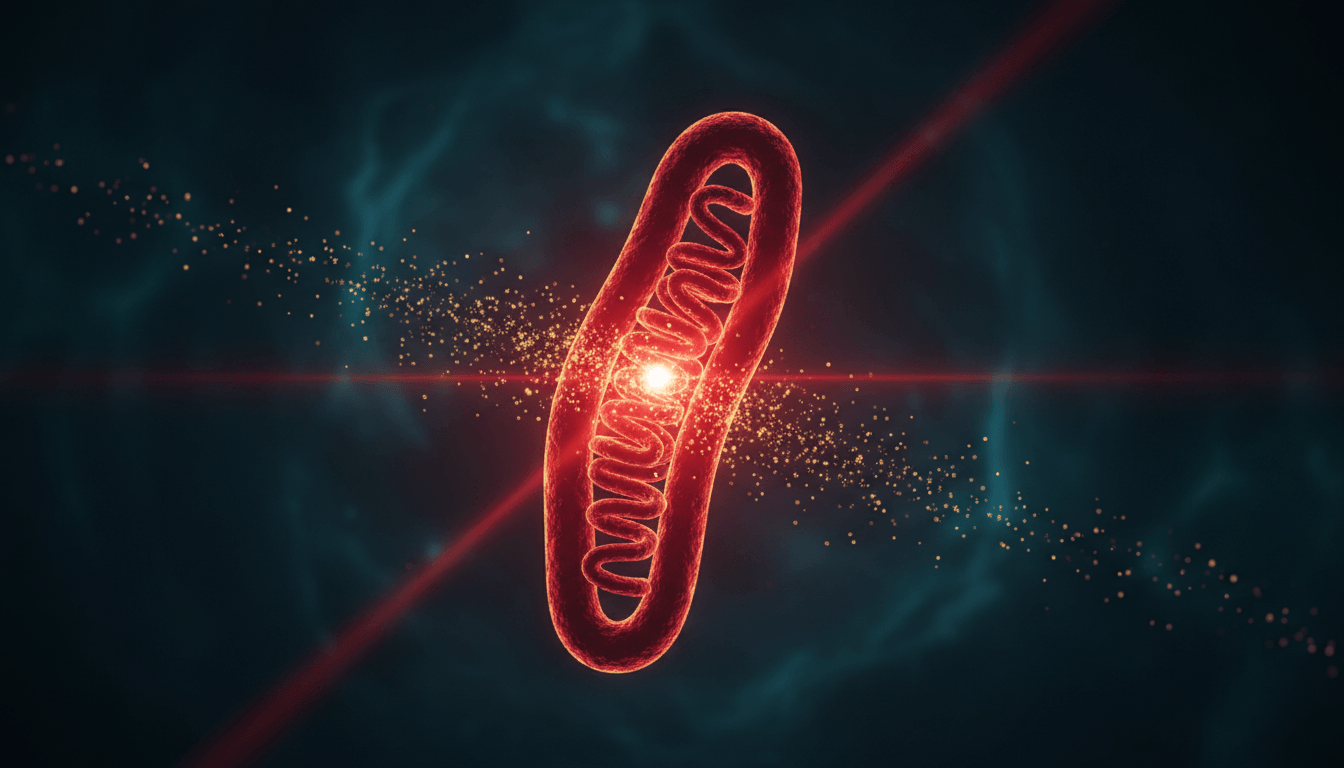
In the 1980s, a biophysicist named Tiina Karu at the Russian Academy of Sciences pointed a red laser at cells and measured what happened. She found that one specific protein inside mitochondria was absorbing the light. Not the cell membrane. Not the DNA. A single enzyme buried in the energy-production machinery.
That enzyme is cytochrome c oxidase. And understanding what light does to it explains almost everything about red light therapy.
The Enzyme That Runs on Light
Cytochrome c oxidase (Complex IV, if you want the technical name) sits at the end of the mitochondrial electron transport chain. Its job is simple but critical. It takes electrons from cytochrome c, transfers them to oxygen, produces water, and drives the proton pump that generates ATP. Every repair job, every protein built, every signal sent between neurons costs ATP.
There's a catch. Nitric oxide competes with oxygen at the enzyme's active site. When it binds there, it blocks electron transport and slows ATP production. This is a normal regulatory mechanism. But in stressed, damaged, or aging cells, nitric oxide accumulates. The brake gets stuck.
Red light (630-670nm) and near-infrared light (810-850nm) get absorbed directly by cytochrome c oxidase. That absorption knocks the nitric oxide loose. Two things happen at once. The freed nitric oxide drifts out into surrounding tissue and triggers vasodilation (more blood flow). And the unblocked enzyme goes back to full speed, cranking out ATP.
Light hits enzyme. Enzyme releases inhibitor. Cell makes more energy.
That's the entire foundational mechanism. Not metaphor. Not "energy" in the wellness-influencer sense. Measurable increases in ATP output from a photochemical interaction with a known protein target.
Karu Proved It Wasn't Random
Karu's insight wasn't just that cells responded to light. Lots of things respond to light. Her contribution was identifying the specific chromophore (the molecule that absorbs photons and converts them into biochemical change). She showed that the action spectra for cellular responses to red and NIR light closely matched the absorption spectra of cytochrome c oxidase.
Translation: the wavelengths that made cells do things were the exact same wavelengths this enzyme absorbs best. That's not correlation. That's a target identification.
What Happens After the Switch Flips
Michael Hamblin, formerly at Harvard Medical School and MIT, is probably the most cited researcher in photobiomodulation. His 2017 review in AIMS Biophysics mapped the full cascade that follows cytochrome c oxidase activation.
ATP goes up first. That's the direct effect. Cells with more ATP have more resources for repair, replication, and protein synthesis, which is why damaged tissue responds more dramatically than healthy tissue. Healthy cells are already running fine. Stressed cells have the most to gain.
Then a controlled burst of reactive oxygen species. Not the destructive kind. A brief, signaling-level pulse that acts like a fire alarm. Nothing burns down. The response crew wakes up.
That ROS signal activates transcription factors like NF-kB and Nrf2. They move into the cell nucleus and start switching on gene expression programs: anti-inflammatory cytokines, antioxidant enzymes like catalase and superoxide dismutase, growth factors. VEGF for blood vessels. BDNF for neurons. NGF for nerves. TGF-beta for tissue repair.
And the displaced nitric oxide causes vasodilation in the treated area. More blood flow on top of more ATP.
A 2024 review in the journal Cells confirmed this same sequence. Cytochrome c oxidase activation leads to enhanced ATP synthesis and calcium release through ion channels, triggering the full downstream cascade.
So one photochemical event at a single enzyme sets off a chain reaction that touches energy production, inflammation, gene expression, blood flow, and tissue repair. That's why the clinical applications are so broad. It's not that light does 50 different things. It does one thing that has 50 consequences.
The Dose Problem Nobody Talks About
The most important and most ignored principle in photobiomodulation is the biphasic dose response. Also called the Arndt-Schulz curve. The relationship between light dose and biological effect isn't linear. It's a bell curve.
Too little light: nothing happens. Optimal dose: therapeutic benefit. Too much light: you overshoot into excess ROS, heat damage, and paradoxical inflammation.
The therapeutic window for most applications falls between 1-50 J/cm² (joules per square centimeter). Most clinical studies producing real results use 3-10 J/cm². Most consumer devices, used at the distances and durations people actually use them? They deliver significantly less.
This is one of the biggest reasons home results don't match clinical results. Not because the science is wrong. Because the dose is wrong.
It also means more is not better. Longer sessions or overpowered devices held too close don't give you extra benefits. They push you past the therapeutic window into the inhibitory zone. The same pattern shows up everywhere in the body. Sixty minutes of deep tissue massage doesn't heal twice as fast as thirty. Extra training volume past a point stops building muscle and starts breaking it down. The body has an optimal input range for almost everything.
The mechanism is real. The research is solid. The challenge is getting the dose right and not falling for marketing claims from companies selling panels that can't actually deliver clinical-grade energy densities. But that's a different article.
The science starts with one enzyme, one photon, and one displaced molecule. Everything else follows from there.
Part of the Red Light Therapy series.
Sources
- Hamblin MR. "Mechanisms and applications of the anti-inflammatory effects of photobiomodulation" (2017, AIMS Biophysics) (opens in new tab)
- Wunsch A, Matuschka K. "A Controlled Trial to Determine the Efficacy of Red and Near-Infrared Light Treatment" (2014, Photomedicine and Laser Surgery) (opens in new tab)
- Photobiomodulation Therapy on Brain (2024, Cells) (opens in new tab)
- Photobiomodulation: A review of the molecular evidence (2021, Journal of Plastic, Reconstructive & Aesthetic Surgery) (opens in new tab)
- Karu TI. "Multiple roles of cytochrome c oxidase in mammalian cells under action of red and IR-A radiation" (2010, IUBMB Life)