Your Red Light Panel Probably Isn't Doing What You Think
The difference between red light therapy that works and red light therapy that doesn't comes down to four variables most people get wrong.

Justin Angeles
· 5 min read
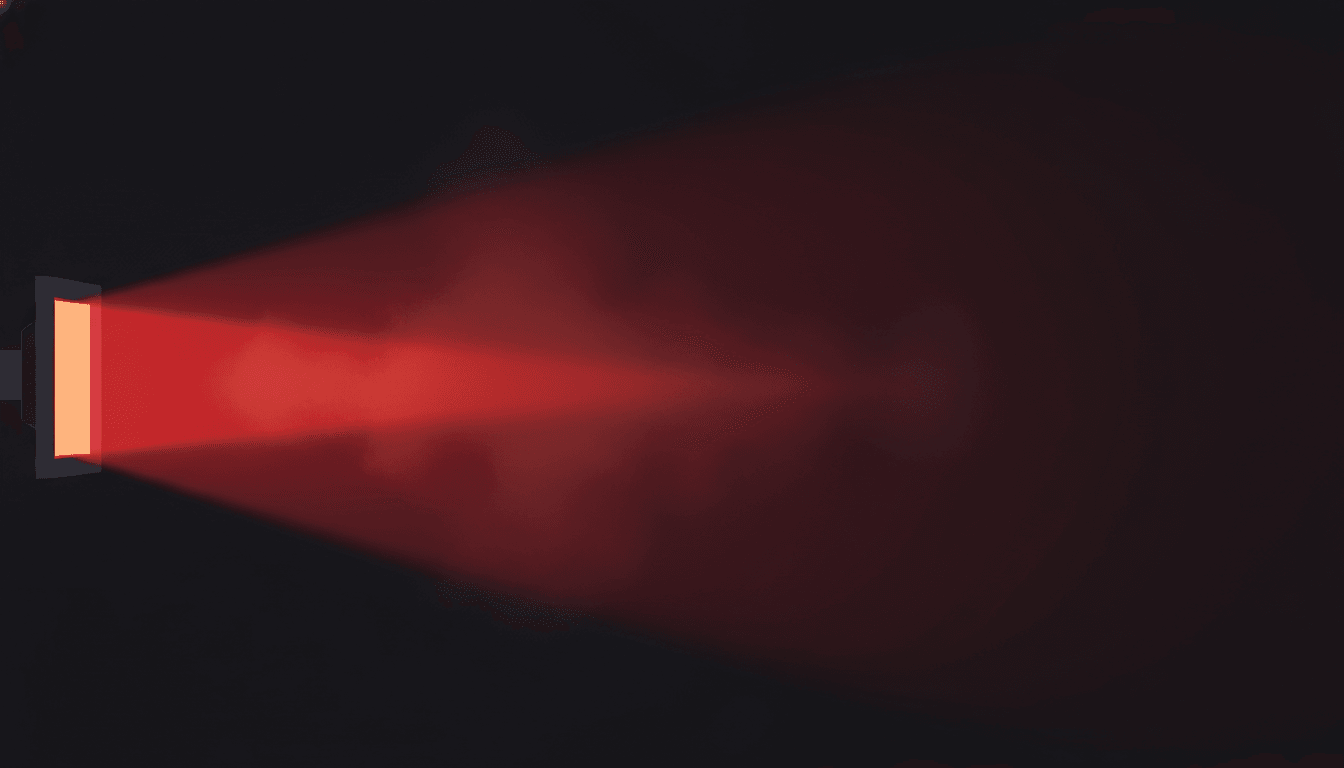
A panel claiming 100 mW/cm² at the device face delivers roughly 25 mW/cm² at 6 inches from your skin. At 12 inches, you're down to maybe 11 mW/cm². That's the difference between a therapeutic dose and an expensive nightlight.
The gap between "red light therapy works in clinical studies" and "red light therapy works on your wall at home" is almost entirely a dosing problem. Four variables determine whether photons actually do anything useful once they leave the LEDs. Most consumer protocols get at least two of them wrong.
The Four Variables
Wavelength decides what the light can reach. Red light in the 630-670nm range gets absorbed in the epidermis and upper dermis. Good for skin. Near-infrared at 810-850nm penetrates deeper into muscle, joint tissue, and organs like the thyroid. The 1064nm wavelength used in some transcranial studies (opens in new tab) punches even deeper but requires significantly more power.
Irradiance is power density. Milliwatts per square centimeter hitting the tissue. Clinical devices typically deliver 10-200 mW/cm² at the skin surface. This is the number manufacturers love to inflate.
Distance kills irradiance. It follows the inverse square law. Double your distance, quarter your power. A device at 100 mW/cm² pressed against the surface drops to roughly 25 mW/cm² at 2 inches and 11 mW/cm² at 3 inches. Almost no consumer protocol accounts for this.
Duration combines with irradiance to give you total energy dose, measured in joules per square centimeter. The math: mW/cm² multiplied by seconds, divided by 1000. Most clinical studies target somewhere between 3 and 50 J/cm² at the tissue. That's the therapeutic window.
What the Studies Actually Use
The protocols that produced real results in peer-reviewed research look like this.
For skin and collagen, Wunsch and Matuschka's 2014 controlled trial (opens in new tab) used 630-660nm red light at 3-10 J/cm², sessions of 10-20 minutes, two to three times per week. That produced measurable improvements in collagen density and wrinkle reduction.
Joint pain protocols use 800-850nm near-infrared at higher doses. 4-20 J/cm² applied directly to the joint for 2-5 minutes, three to five times per week. Hamblin's 2017 review (opens in new tab) documented the anti-inflammatory mechanisms that make this work.
Ferraresi and colleagues (opens in new tab) found muscle recovery benefits at 10-50 J total per muscle group, 5-10 minutes, applied either before or immediately after exercise. The pre-exercise timing is interesting. Light primes the mitochondria before you stress them.
Hair growth studies like Lanzafame's 2013 trial (opens in new tab) used 650-670nm at 4-6 J/cm² across the full scalp, 15-25 minutes per session, three times per week. The REVIAN clinical trials in 2023 confirmed similar protocols for androgenetic alopecia.
Transcranial photobiomodulation (opens in new tab) is the most device-specific. 810-1064nm, 8-12 minute sessions, typically three times per week in research settings. Getting enough photons through the skull is the hard part.
More Is Not Better
This is where people mess up. The Arndt-Schulz curve means there's a sweet spot. Below the threshold, nothing happens. In the window, you get the beneficial hormetic response. Above it, you're generating enough reactive oxygen species to flip from helpful signal to actual damage.
Most confirmed benefits land in the 1-50 J/cm² range. Doubling your session time doesn't double the benefit. It can reverse it. Longer sessions past the therapeutic window produce local heat effects and inflammation. The opposite of what you wanted.
Morning Wins
Jeffery's eye studies at UCL found that morning red light exposure produced significantly better outcomes than afternoon sessions. This tracks with what we know about mitochondrial function following circadian rhythms. Your mitochondria are more responsive to photobiomodulation during certain phases of their daily cycle.
Only directly tested in retinal applications so far. But the mechanism is general enough that morning or midday sessions are a reasonable default for any protocol.
The Consumer Device Reality
Premium panels from companies like Joovv and PlatinumLED have been independently tested and generally deliver what they claim at the device face. The problem is that "at the device face" isn't where your skin is. At the recommended 6-12 inch distance, irradiance drops 50-75%. A panel rated at 100 mW/cm² delivers 25-50 mW/cm² at your skin.
Run the math on a 10-minute session at 30 mW/cm². That's 18 J/cm². Within the therapeutic window for skin applications. Probably fine.
Generic budget panels are a different story. Independent testing frequently shows they don't hit their claimed numbers even at the device surface. At treatment distance, some deliver doses so low they'd need 30-40 minute sessions to reach minimum therapeutic thresholds.
You see this constantly. Someone swears their $60 Amazon panel changed their life. Someone else paid $600 and noticed nothing. The difference usually isn't the person. It's whether the photons actually showed up at the dose the research says matters.
The science works. The physics doesn't care about your brand loyalty. Measure the distance, check the specs, do the multiplication.
Sources
- Hamblin MR. "Mechanisms and applications of the anti-inflammatory effects of photobiomodulation." AIMS Biophysics, 2017. PMC5523874 (opens in new tab)
- Wunsch A, Matuschka K. "A Controlled Trial to Determine the Efficacy of Red and Near-Infrared Light Treatment." Photomedicine and Laser Surgery, 2014. PMC3926176 (opens in new tab)
- Zhao et al. "Transcranial photobiomodulation enhances visual working memory capacity." Science Advances, 2022. sciadv.abq3211 (opens in new tab)
- Jeffery et al. "Morning exposure to deep red light improves declining eyesight." UCL / Scientific Reports, 2021.
- Lanzafame et al. "The growth of human scalp hair mediated by visible red light laser and LED sources." Lasers in Surgery and Medicine, 2013. PubMed 24078483 (opens in new tab)
- Ferraresi et al. "Photobiomodulation in human muscle tissue." Journal of Biophotonics, 2016. PMC5167494 (opens in new tab)
- REVIAN clinical trial results for androgenetic alopecia, 2023.
- "Photobiomodulation Therapy on Brain." Cells, 2024. MDPI (opens in new tab)