The Hair Loss Treatment That Doesn't Come in a Bottle
Red light therapy for hair growth has FDA-cleared devices, multicenter trials, and results comparable to minoxidil. Without the side effects.

Justin Angeles
· 4 min read
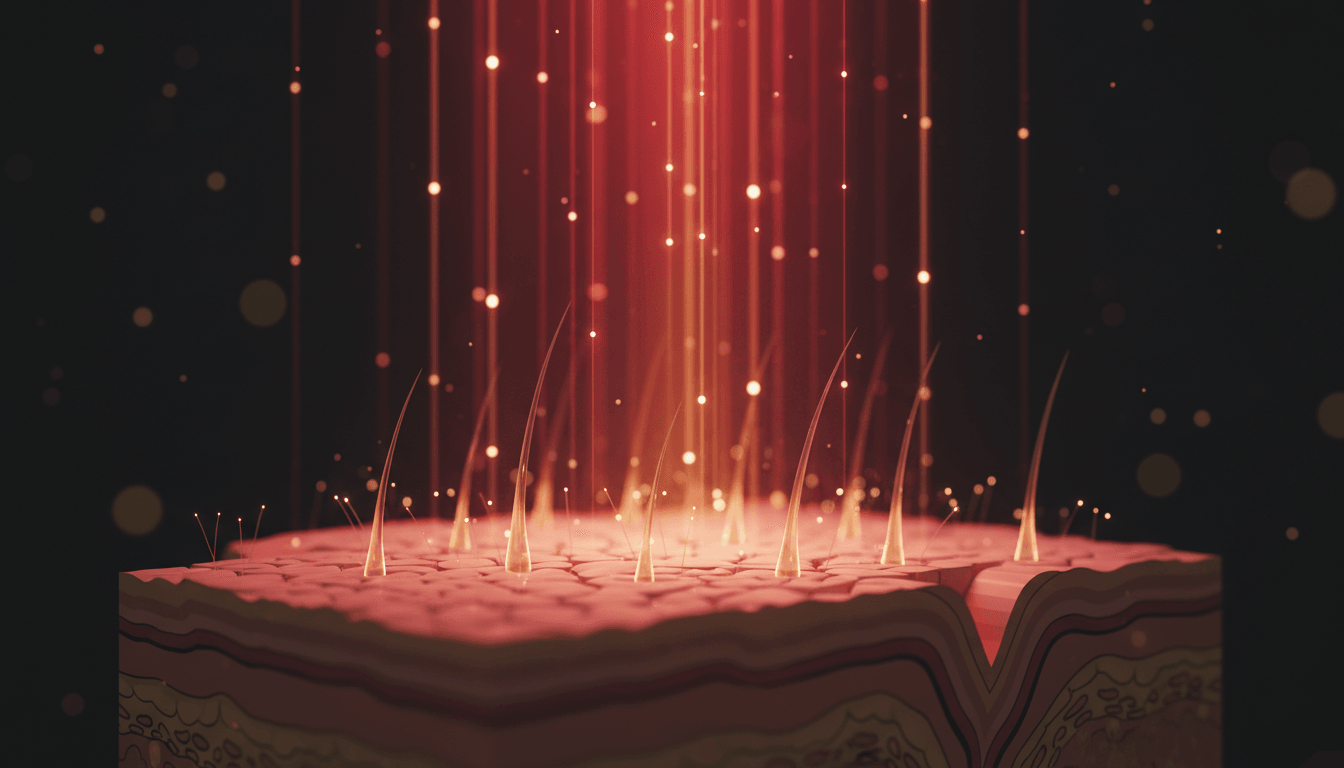
In 2013, the researcher R.J. Lanzafame ran a randomized, double-blind, sham-controlled trial on men with androgenetic alopecia. He shone 655nm red light on their scalps. The treated group grew 35% more hair than the placebo group.
The study didn't get much press. You can't patent a wavelength.
Why Follicles Respond to Light
Hair follicles are more metabolically demanding than most people realize. Growing a single hair strand requires follicle cells to divide at extraordinary speed. That takes energy. A lot of ATP.
Every follicle cell has mitochondria. Those mitochondria contain cytochrome c oxidase, the same enzyme from article one that makes red light work everywhere else in the body. When 630-670nm light hits a follicle, that enzyme activates. ATP goes up. Growth factors get upregulated. Stem cell factor. Hepatocyte growth factor. They push follicles from the telogen phase (resting) into the anagen phase (active growth).
In androgenetic alopecia, the problem is follicles miniaturizing and spending too much time in telogen. Light wakes them up. The mechanism isn't special to hair. It's the exact same photochemical cascade. Hair just happens to respond because follicle cells are energy-hungry.
The Trials
Lanzafame's 2013 study had men do 25-minute scalp treatments three times per week for 26 weeks. Significant increase in hair density. Double-blind. Sham-controlled.
The bigger test came in 2023. REVIAN, a company with FDA-cleared medical-grade LED devices, completed a multicenter randomized controlled trial on androgenetic alopecia using 630nm light. Significant improvement in hair count versus sham. Multi-site. That's the kind of trial that moves findings from "interesting study" to clinical weight.
Multiple meta-analyses confirm the pattern. Red light therapy for androgenetic alopecia has more controlled trial evidence behind it than most people know.
Compared to Minoxidil
Minoxidil works. It's the baseline everyone compares hair loss treatments to. It stimulates follicles through K+ channel opening and vasodilation. Different mechanism, similar result: more anagen-phase follicles.
Some head-to-head studies have found PBM producing comparable results to 2% minoxidil. Not always, and minoxidil's evidence base is older and larger. But the comparison matters because minoxidil has a real side effect profile. Scalp irritation. An initial shedding phase that panics people into quitting. For women, concerns about systemic absorption. Some men report unwanted facial hair growth.
Red light has no systemic absorption. No shedding phase. The side effect profile is essentially nothing.
That's not a reason to drop minoxidil if it's working. It's a reason the comparison is worth making.
The Green LED Problem
Some consumer laser caps include green LEDs (around 520nm) alongside red and near-infrared, marketing this as "multiple therapeutic wavelengths."
Green light doesn't activate cytochrome c oxidase. Wrong wavelength, wrong chromophore. There's evidence that green light can actually interfere with PBM effects, competing for absorption in the tissue without triggering the therapeutic cascade.
"More wavelengths" is not better. If those extra wavelengths include green, you may be diluting the only wavelengths doing anything useful.
The Consumer Device Reality
Proper scalp coverage requires multiple emitters positioned close to the skin surface. The FDA-cleared devices that produced clinical results delivered calibrated doses across the full scalp. Consumer laser caps range from legitimate clinical-grade equipment to plastic helmets with a handful of LEDs that couldn't treat a postage stamp at therapeutic dose.
Protocol matters too. Most positive trials ran three sessions per week for 16-26 weeks. Months of consistent treatment. Not a few weeks of casual use before the cap ends up in a drawer.
Hair loss is more emotionally loaded than most health concerns. The evidence here is genuinely good. Better than most people think. Better than the wellness market's hype-and-disappoint cycle deserves.
The mechanism is real. The trials are real. Whether the device you're considering delivers enough photons at the right wavelength at the right dose is a separate question. And it's the question most marketing won't help you answer.
Part of the Red Light Therapy series. Previous: Why Red Light Beats Ice for Sore Muscles. Next: 73% Antibody Reduction. From Light..
Sources
- Lanzafame RJ et al. "The growth of human scalp hair mediated by visible red light laser and LED sources in males" (2013, Lasers in Surgery and Medicine) (opens in new tab)
- Hamblin MR. "Mechanisms and applications of the anti-inflammatory effects of photobiomodulation" (2017, AIMS Biophysics) (opens in new tab)
- Photobiomodulation: A review of the molecular evidence (2021, Journal of Plastic, Reconstructive & Aesthetic Surgery) (opens in new tab)
- REVIAN RED multicenter randomized clinical trial for androgenetic alopecia, 2023 (opens in new tab)