Your Brain on Psychedelics Is Your Brain with the Filter Off
Psychedelics don't add anything to your brain. They remove the predictions that constrain it. The REBUS model explains why that's therapeutic.

Justin Angeles
· 7 min read

People who take psilocybin keep saying the same thing. "It felt like seeing reality for the first time." Not a hallucination. Not an escape. The opposite. Like a filter they didn't know existed had been switched off.
For decades, that description sounded like druggie mysticism. Then predictive processing came along and turned it into a testable neuroscience claim.
Your brain, as we've covered in this series, doesn't passively receive reality. It generates a prediction of reality and checks that prediction against incoming data. What you experience as "seeing" is mostly your brain's best guess, lightly corrected by sensory input. Andy Clark calls this the "controlled hallucination" model. You're not perceiving the world. You're perceiving your brain's prediction of the world.
Psychedelics mess with the predictions.
REBUS: The Anarchic Brain
Robin Carhart-Harris spent years at Imperial College London (now at UC San Francisco) studying what psilocybin does to the brain. In 2019, he and Karl Friston published a model called REBUS. Relaxed Beliefs Under Psychedelics.
The name tells you the theory. Psychedelics relax the brain's high-level beliefs. The deep priors. The confident predictions that normally sit at the top of the hierarchy and constrain everything below them. Your sense of self. Your assumptions about what's possible. Your model of who you are and how the world works.
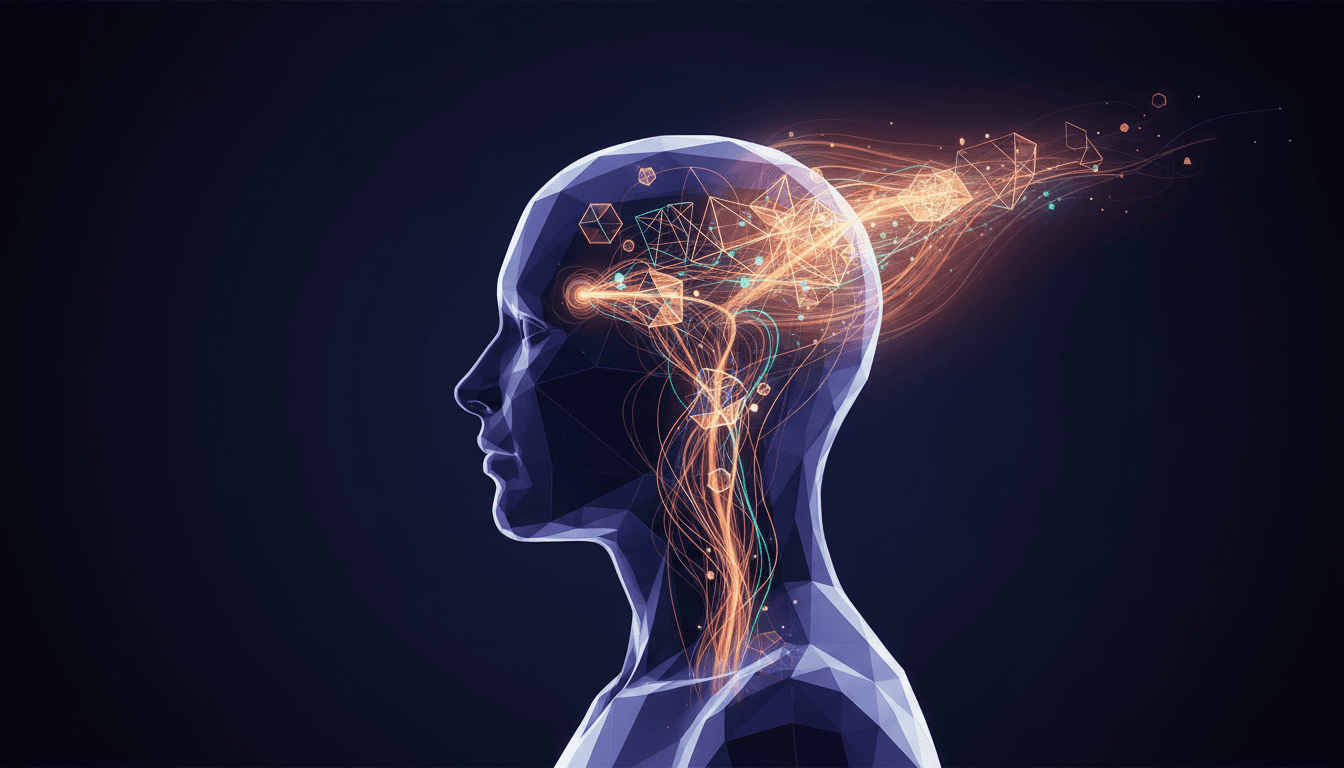
Under psilocybin, those top-down predictions lose their grip. Bottom-up sensory data floods the system without being squeezed through the usual filters. Your brain is still generating predictions, but the confident ones that normally dominate have been turned way down.
That's what "seeing reality for the first time" actually means. You're getting less-filtered sensory information because your prediction machine loosened its hold.
The Default Mode Network Goes Quiet
The neural mechanism maps onto a specific brain network. The default mode network. The DMN.
Carhart-Harris and colleagues published a study in PNAS in 2012 showing that psilocybin decreases activity in the DMN. This was surprising. Most people assumed psychedelics would increase brain activity everywhere. Instead, the most dramatic change was a reduction. The brain's prediction-maintenance system went quiet.
The DMN is active when you're thinking about yourself. Ruminating. Planning. Running your internal narrative. In predictive processing terms, it maintains your highest-level priors. Your self-model. Your ego. The story of who you are.
Psilocybin turns down that network. And the degree of DMN disruption correlates directly with the subjective intensity of the experience. The more the self-model loosens, the more profound the trip.
In Bayesian terms (Friston's framework from his 2005 paper on cortical responses), confident priors lose their precision-weighting. They stop suppressing prediction errors. And when prediction errors aren't suppressed, they propagate up the hierarchy and start rewriting the model.
Your brain, temporarily, becomes updatable in ways it normally isn't.
Depression as a Locked Prediction
Depression, in the predictive processing framework, looks like a specific kind of malfunction. The brain has built deeply confident priors. Nothing will ever get better. I am fundamentally worthless. Trying is pointless. These predictions are assigned extremely high precision. They resist updating.
New experiences that should generate prediction errors and force model revision just get filtered out. Someone compliments you. Your brain says "they're just being polite" and discards the error signal. You get a promotion. "It won't last." You have a good day. "It's temporary."
The prediction machine isn't broken. It's locked onto the wrong model, and the confidence assigned to that model is so high that contradictory evidence can't get through.
Lisa Feldman Barrett's constructed emotion framework fits here too. Emotions aren't reactions to the world. They're predictions about it, constructed from prior experience. Depression isn't a reaction to a bad life. It's a model that predicts a bad life and then filters reality to confirm the prediction.
Carhart-Harris and colleagues published a 2018 study in Psychopharmacology showing psilocybin-assisted therapy produced rapid and sustained reductions in treatment-resistant depression. Brain imaging confirmed decreased DMN rigidity. The rigid predictions had been loosened. New data could get through.
Treatment-resistant is the key phrase. These were people whose brains had resisted updating through conventional means. Talk therapy. SSRIs. Years of effort. The predictions were locked.
Psilocybin didn't add a new chemical. It removed the lock.
Psilocybin vs. SSRIs: Two Different Mechanisms
In 2021, Carhart-Harris published a trial in the New England Journal of Medicine comparing psilocybin with escitalopram (a standard SSRI) for major depression. Both treatments reduced symptoms by similar amounts. But the way they worked appeared fundamentally different.
SSRIs blunt emotional reactivity. In predictive processing terms, they reduce the intensity of prediction errors. The bad feelings get quieter. The model doesn't change. You still believe "nothing will work." You just feel less terrible about it.
Psilocybin doesn't blunt the errors. It loosens the predictions that the errors are bouncing off. The model itself becomes updatable. Patients in the psilocybin group showed larger improvements on secondary outcomes including emotional responsiveness and feelings of connectedness. They weren't just feeling less bad. They were feeling differently.
That distinction matters enormously. One approach manages symptoms. The other rewrites the underlying model that generates the symptoms.
The Therapeutic Window
Psychedelics don't permanently dissolve your predictions. The effect is temporary. Your DMN comes back online. Your self-model reconsolidates. But there's a window, hours to days, where the rigid priors are softened and the brain is more receptive to new information.
This is why set and setting matter so much. The psychedelic opens the window. What happens during that window determines what new predictions get written in.
Most therapy tries to overpower rigid predictions with strong new evidence. Psychedelics do something more direct. They temporarily reduce the rigidity itself. The same evidence that bounced off a locked model can now reach it and update it.
Top-down. Bottom-up. Normally top wins. Psychedelics briefly flip that balance.
Beyond the Drug
You don't need to take psychedelics to understand the principle.
Your brain right now has confident predictions filtering your experience. About what you're capable of. About what other people think of you. About what's possible. Some are accurate. Some are outdated. Some were never accurate. They were just assigned too much confidence by a brain trying to be efficient.
The REBUS principle applies beyond drugs. Anything that loosens rigid predictions creates an opportunity for updating. Novel environments. Challenging experiences. Meditation. Even exercise. Norman Farb's 2007 study showed mindfulness shifts processing away from the narrative self toward direct sensory experience. A mild version of the same thing.
The prediction machine is powerful. Efficient. Stubborn. It builds models and defends them against contradictory evidence because changing models is expensive.
Sometimes the most therapeutic thing you can do is find a way to make the machine less sure of itself.
Certainty is the enemy of growth. Not uncertainty itself, but the brain's fierce commitment to predictions it built in a different context, for a different version of you.
The predictions can be updated. But only if you can get the errors through the door.
Sources
- REBUS and the Anarchic Brain: Toward a Unified Model of the Brain Action of Psychedelics (Carhart-Harris & Friston, 2019, Pharmacological Reviews) (opens in new tab)
- Neural Correlates of the Psychedelic State as Determined by fMRI Studies with Psilocybin (Carhart-Harris et al., 2012, PNAS) (opens in new tab)
- Trial of Psilocybin versus Escitalopram for Depression (Carhart-Harris et al., 2021, New England Journal of Medicine) (opens in new tab)
- A Theory of Cortical Responses (Friston, 2005, Philosophical Transactions of the Royal Society B) (opens in new tab)
- Whatever Next? Predictive Brains, Situated Agents, and the Future of Cognitive Science (Clark, 2013, Behavioral and Brain Sciences) (opens in new tab)
- Being You: A New Science of Consciousness (Seth, 2021, Dutton/Faber & Faber) (opens in new tab)
- The Experience Machine: How Our Minds Predict and Shape Reality (Clark, 2023, Pantheon) (opens in new tab)
- How Emotions Are Made: The Secret Life of the Brain (Barrett, 2017, Houghton Mifflin Harcourt) (opens in new tab)
- Attending to the Present: Mindfulness Meditation Reveals Distinct Neural Modes of Self-Reference (Farb et al., 2007, Social Cognitive and Affective Neuroscience) (opens in new tab)
Part of the Prediction Machine series. Previous: Why Sugar Pills Actually Work. Next: You Don't Have a Spotlight in Your Head.