Your Anxiety Is a Weather Forecast That's Always Wrong
Predictive processing reframes anxiety not as excessive fear but as a miscalibrated prediction system, one that's stuck forecasting storms that never arrive.

Justin Angeles
· 7 min read

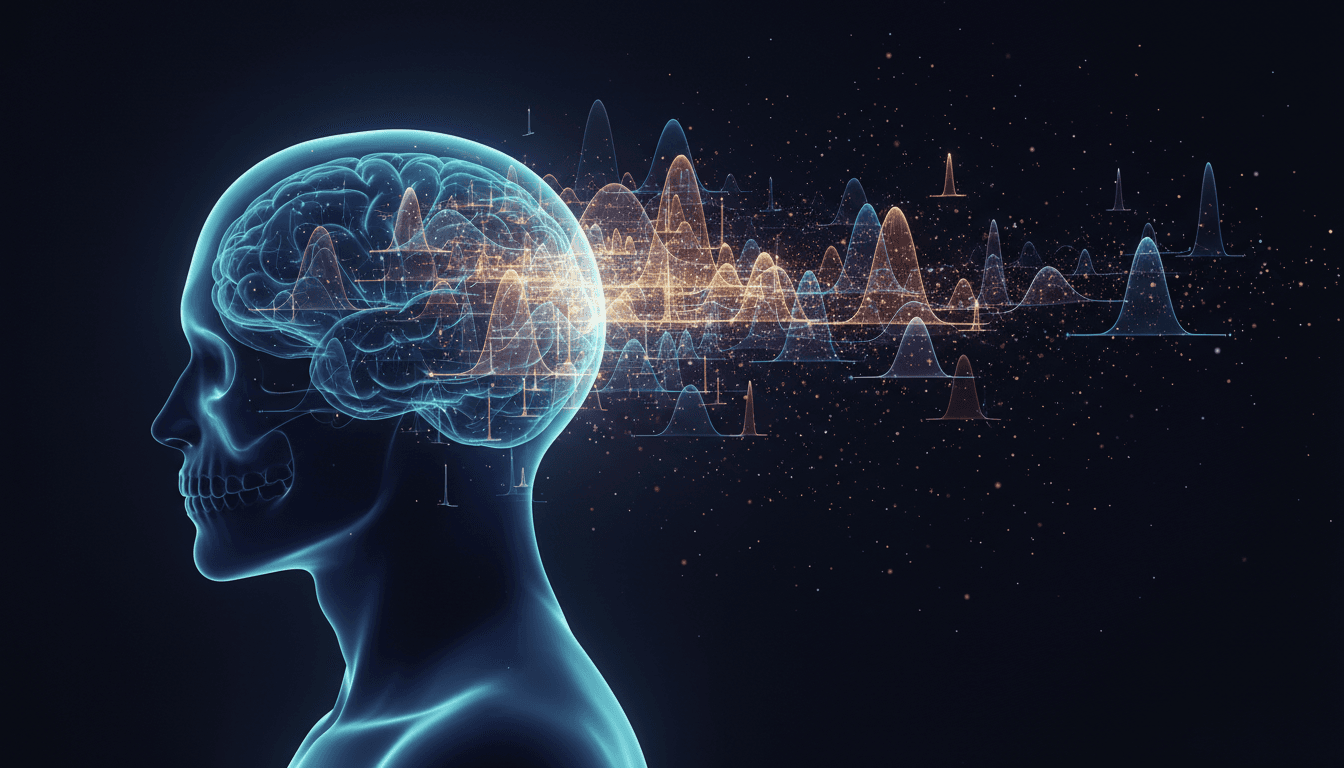
Your brain is a weather forecaster. Wakes up every morning, checks its internal models, generates predictions about what's coming. Will this conversation go badly? Will that email contain bad news? Will the chest tightness mean something terrible?
Anxiety is what happens when the forecaster breaks. Not broken like it stopped working. Broken like it's predicting hurricanes every single day in a city that hasn't seen one in decades.
If you've been following this series, you know the core idea. Your brain doesn't passively receive reality. It generates predictions, checks them against sensory data, and the gap between prediction and reality is a prediction error. Those errors are the only signals that update your model of the world.
Emotions, as Lisa Feldman Barrett proposed in her theory of constructed emotion, are themselves predictions. Your brain predicts what your body will need in the next few seconds and pre-builds the emotional state to match. Fear before the threat arrives. Anger before the confrontation. Sadness before the loss is confirmed.
Anxiety is a specific corruption of this system. The brain chronically over-predicts threat. Not because the world got more dangerous. Because the prediction machinery itself is miscalibrated.
The Precision Problem
In Bayesian terms (which is how predictive processing models the brain), every prediction comes with a confidence level. Karl Friston calls this "precision." High precision means the brain treats a signal as important and reliable. Low precision means it gets filtered out as noise.
Healthy brains assign low precision to most body signals. Your heart rate fluctuates constantly. Your breathing changes. Your gut gurgles. Your muscles twitch. These are normal variations, and your brain's prediction system smooths over them without you ever noticing.
Sahib Khalsa and Martin Paulus at the Laureate Institute for Brain Research found something different in people with panic disorder. In a 2018 paper in Biological Psychiatry, they showed heightened sensitivity to interoceptive prediction errors. Normal heartbeat variations that a healthy brain filters out? The anxious brain flags them as important. Assigns high precision. Generates a prediction. Something is wrong with my heart.
The interoceptive prediction machinery is turned up too high. Every body signal becomes a potential emergency broadcast.
This is why anxiety feels so physical. The racing heart, the tight chest, the churning stomach. These aren't just symptoms of anxiety. They're the content of anxiety. The brain is generating threat predictions about its own body and experiencing those predictions as real sensations. Anil Seth calls this the brain constructing bodily experience from the inside out, not passively reading signals from the body.
Why Anxiety and Depression Travel Together
Here's something the prediction model explains beautifully. Anxiety and depression co-occur at staggering rates. About 60% of people with anxiety also have symptoms of depression. Traditional models struggle to explain why two seemingly opposite states (hypervigilance versus withdrawal) show up in the same person.
Predictive processing makes it simple. Both are precision-weighting disorders. They're just miscalibrated in different directions.
Anxiety overweights prediction errors. Every mismatch between expectation and reality gets flagged as urgent. The world feels unpredictable, dangerous, full of signals that demand attention. Everything is too loud.
Depression overweights priors. The brain's existing model ("nothing will work," "I can't change anything," "there's no point") is held with such high confidence that incoming sensory evidence to the contrary gets suppressed. Good things happen and they don't register. The model says nothing good is coming, and the model wins.
Barrett, Quigley, and Hamilton proposed this framework, and computational models by Moran and colleagues formalized it mathematically. Same system. Same architecture. Two different ways it breaks.
After losing my best friend Riley, I lived in both states for years. Hypervigilant about everything that could go wrong. Simultaneously convinced nothing I did would matter anyway. Prediction system broken in both directions at once.
Why Avoidance Is the Worst Possible Fix
If your brain makes a prediction ("this situation is dangerous") and you avoid the situation, what happens to the prediction?
Nothing. It never gets tested.
No test means no prediction error. No prediction error means no update to the model. The threatening prediction persists. And it might actually get stronger, because your brain can interpret the avoidance itself as confirming evidence. You ran, so the threat must have been real.
This is the cruelest trick of anxiety. The thing that feels most protective (avoiding what scares you) is the thing that keeps the system broken. You're a weather forecaster who predicts a hurricane, boards up the windows, and then when the hurricane doesn't come, concludes that the boards must have stopped it.
Andy Clark, in "The Experience Machine," describes this as the brain becoming trapped in a self-confirming loop. The predictions generate the avoidance, and the avoidance prevents the predictions from being corrected. The model becomes hermetically sealed against disconfirming evidence.
Why Therapy Works (Through a Prediction Lens)
Cognitive behavioral therapy is, at its core, a prediction error generator.
You believe "if I speak up in the meeting, everyone will think I'm stupid." CBT asks you to test it. You speak up. People respond normally. Maybe someone says "good point." The catastrophe didn't happen.
That gap is a prediction error. Prediction errors are the only signals that update the model. Do this enough times and the old belief starts losing confidence.
Exposure therapy is even more direct. Michelle Craske and colleagues published a landmark reframing in Behaviour Research and Therapy (2014) that shifted the field. Exposure doesn't work through habituation. It works through "inhibitory learning." You're not extinguishing the old fear prediction. You're building a new, competing prediction that says this situation is actually safe.
The old prediction doesn't disappear. It just gets outcompeted. Which is why anxiety can come back after successful treatment. Under enough stress, fatigue, or novel circumstances, the old threat model resurfaces. Relapse isn't failure. It's the old forecast breaking through when the new one is temporarily weakened.
Recalibrating the Forecaster
The goal isn't to stop predicting. You can't. Prediction is the fundamental operation of your brain. The goal is to recalibrate the precision settings.
Norman Farb and colleagues (2007) found that mindfulness shifts neural activity from the default mode network (where your brain runs prediction models on autopilot) to direct sensory processing. You're turning down the precision on predictions and turning up the precision on what's actually happening right now.
Exercise does it through a different mechanism. Broman-Fulks and colleagues (2004) showed aerobic exercise reduces anxiety sensitivity, the tendency to catastrophize about body sensations. Running makes your heart pound, breathing heavy, muscles burn. Nothing bad happens. Your brain learns that elevated heart rate doesn't equal danger. Repeated across hundreds of workouts, it recalibrates the interoceptive system.
This is why the standard advice (exercise, meditation, therapy, gradual exposure) actually works. Every one of these interventions generates controlled prediction errors that update the brain's miscalibrated threat model.
Your anxiety isn't a character flaw. It isn't weakness. It isn't something wrong with who you are. It's a forecasting system that's been set to predict storms with too much confidence and ignore clear skies. The forecast can be recalibrated. But only if you're willing to step outside and check the actual weather.
Sources
- A Theory of Cortical Responses (Friston, 2005, Philosophical Transactions of the Royal Society B) (opens in new tab)
- Whatever Next? Predictive Brains, Situated Agents, and the Future of Cognitive Science (Clark, 2013, Behavioral and Brain Sciences) (opens in new tab)
- The Experience Machine: How Our Minds Predict and Shape Reality (Clark, 2023, Pantheon) (opens in new tab)
- Being You: A New Science of Consciousness (Seth, 2021, Dutton/Faber & Faber) (opens in new tab)
- The Theory of Constructed Emotion (Barrett, 2017, Social Cognitive and Affective Neuroscience) (opens in new tab)
- How Emotions Are Made: The Secret Life of the Brain (Barrett, 2017, Houghton Mifflin Harcourt) (opens in new tab)
- Interoception and Mental Health: A Roadmap (Khalsa et al., 2018, Biological Psychiatry: Cognitive Neuroscience and Neuroimaging) (opens in new tab)
- The Predictive Mind (Hohwy, 2013, Oxford University Press) (opens in new tab)
- Maximizing Exposure Therapy: An Inhibitory Learning Approach (Craske et al., 2014, Behaviour Research and Therapy) (opens in new tab)
- Attention, Uncertainty, and Free-Energy (Feldman & Friston, 2010, Frontiers in Human Neuroscience) (opens in new tab)
- Attending to the Present: Mindfulness Meditation Reveals Distinct Neural Modes of Self-Reference (Farb et al., 2007, Social Cognitive and Affective Neuroscience) (opens in new tab)
- Effects of Aerobic Exercise on Anxiety Sensitivity (Broman-Fulks et al., 2004, Behaviour Research and Therapy) (opens in new tab)
- An Interoceptive Predictive Coding Model of Conscious Presence (Seth, Suzuki & Critchley, 2012, Frontiers in Psychology) (opens in new tab)
Part of the Prediction Machine series. Previous: Your Brain Invents Every Emotion You Feel. Next: Why Sugar Pills Actually Work.