When You Eat Matters More Than What You Eat
Two groups of mice ate the exact same high-fat diet. Same calories. The only difference was timing. After 18 weeks, the time-restricted group weighed 28% less.

Justin Angeles
· 6 min read
In 2012, Satchin Panda's lab at the Salk Institute ran an experiment that should have ended the "calories in, calories out" debate forever.
Two groups of mice. Identical high-fat diet. Identical total calories. The only variable was timing. One group ate whenever they wanted. The other was restricted to an 8-hour feeding window during their active phase.
After 18 weeks, the time-restricted group weighed 28% less. Lower cholesterol. Less liver fat. Less inflammation. Better glucose tolerance. Same food. Same amount. Completely different outcome.
The study, published in Cell Metabolism, wasn't a fluke. It was a direct challenge to the most basic assumption in nutrition: that what matters is how much you eat, not when.
Your Organs Run on a Schedule
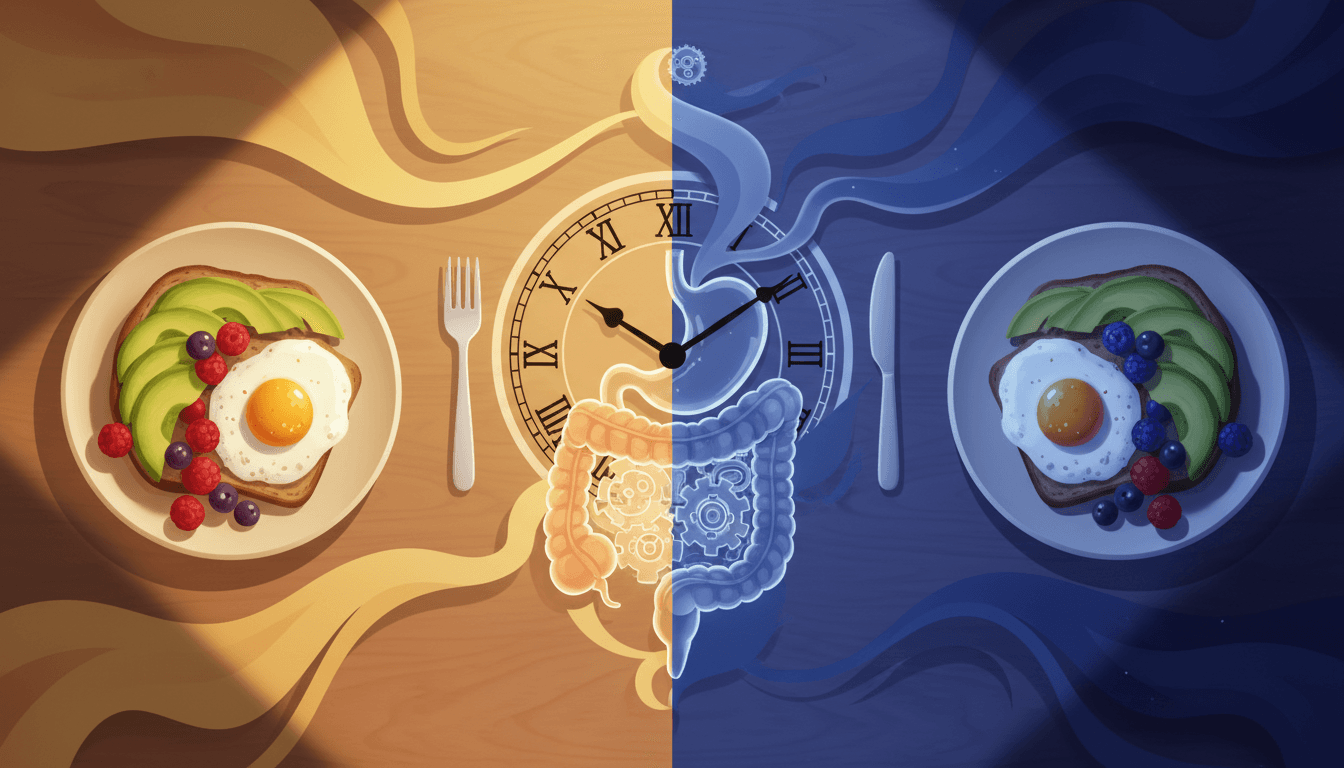
The previous articles in this series established that your body doesn't have one clock. It has billions. Your liver has its own circadian rhythm. So does your pancreas. Your gut. Your adipose tissue. These peripheral clocks aren't decorative. They run temporal programs that determine how your body processes food at any given hour.
Insulin sensitivity peaks in the morning and declines throughout the day. Your liver's ability to metabolize fat follows a rhythm. Your gut microbiome shifts its activity based on time. These aren't suggestions from your body. They're the operating parameters of your metabolic machinery.
Frank Scheer at Brigham and Women's Hospital demonstrated this in a 2009 PNAS study. He fed people identical meals at two different times: circadian day and circadian night. Not clock time. Biological time. The result: eating at circadian night produced a 17% higher glucose response to the exact same food.
Same meal. Different time. Measurably worse metabolic outcome.
The Breakfast Problem
Daniela Jakubowicz at Tel Aviv University published a study in 2013 in Obesity that made the timing effect even harder to ignore.
She put women on a 1,400-calorie diet. Same total calories for everyone. One group ate a large breakfast and small dinner. The other ate a small breakfast and large dinner. Same food. Same calories. Just rearranged.
After 12 weeks, the big-breakfast group lost 2.5 times more weight.
That's not a marginal difference. That's the kind of result that should restructure how we think about diet advice. And yet most nutrition guidance still treats calories as interchangeable units, as if 500 calories at 7am and 500 calories at 11pm are the same thing.
They are not the same thing. Your body processes them differently because your metabolic clocks are in different states at different times. Eating a large meal late at night is asking your liver and pancreas to do heavy work during their biological downtime. They'll do it. Badly.
You're Probably Eating for 15 Hours a Day
In 2015, Shubhroz Gill and Panda published another Cell Metabolism study that shifted the conversation from mice to humans. They used a smartphone app to track the eating patterns of healthy, non-shift-working adults. Not people with weird schedules. Normal people.
The median eating window was 14 hours and 45 minutes.
People were consuming calories from shortly after waking until right before bed. Only about 10% ate within a 12-hour window. Most people's metabolic clocks never got a real break.
When overweight participants in the study voluntarily reduced their eating window to 10-11 hours for 16 weeks, they lost an average of 3.27 kg. They reported better sleep. More energy. And they didn't change what they ate. Just when.
I tracked my own eating window for a month after reading Panda's book The Circadian Code. I thought I was disciplined about food. Turns out I was eating across a 13-hour window most days. A coffee with cream at 7am. A snack at 9pm. Thirteen hours where my liver and pancreas never get to run their maintenance programs.
Fat Genes on the Wrong Schedule
Jonathan Johnston's group at the University of Surrey published a 2018 study in the Journal of Nutritional Sciences that dug into the molecular mechanism behind late eating.
They found that late eating altered gene expression patterns in adipose tissue. Fat metabolism genes were shifted out of their normal circadian phase. The genes responsible for processing and storing fat were being activated at the wrong time.
This connects directly to what Stokkan and colleagues showed back in 2001 in Science. They demonstrated that feeding time entrains the circadian clock in the liver, independent of the central clock in the brain. Feed a mouse at an unusual time and its liver clock shifts to match the new feeding schedule. But the brain's clock stays locked to the light-dark cycle.
Now you have two clocks running on different schedules. The central pacemaker says it's night. The liver says it's time to process food. This is internal desynchronization, and it's the same mechanism that makes shift work so destructive to health.
Except you don't have to work the night shift to create it. Eating a big meal at 10pm does the same thing on a smaller scale. Every night.
The Larger Pattern
This article is the seventh in a series about circadian biology, and a pattern keeps emerging. Light at the wrong time disrupts your central clock. Work at the wrong time disrupts your sleep. Social schedules at the wrong time create jet lag without travel. And now food at the wrong time disrupts your metabolic clocks.
The common thread isn't any single behavior. It's desynchronization. Your billions of clocks drifting out of alignment with each other because modern life sends them conflicting signals.
Roenneberg's work on social jet lag, published in 2012 in Current Biology, showed that the mismatch between biological time and social time correlates with obesity. Lyall and colleagues at the University of Glasgow found in a 2018 Lancet Psychiatry study that disrupted circadian rhythmicity associates with mood disorders, lower wellbeing, and worse cognitive function. Scheer's 2009 research showed that circadian misalignment alone, independent of sleep loss, causes adverse metabolic and cardiovascular consequences.
The body isn't failing. It's responding precisely to contradictory instructions.
What This Actually Means
The practical implication of chrononutrition research is simple, even if it's culturally inconvenient.
Eat earlier. Eat within a shorter window. Stop eating several hours before bed.
You don't need a special diet. You don't need to count macros or buy supplements. You need to eat when your metabolic machinery is expecting food and stop eating when it's expecting rest.
Panda's research suggests a 10-12 hour eating window as a reasonable target. Jakubowicz's work suggests front-loading your calories toward the morning. Scheer's findings suggest avoiding food during your biological nighttime, which for most people starts well before midnight.
None of this requires willpower or expensive interventions. It requires understanding that your body has a temporal architecture and that ignoring it has consequences no amount of calorie counting can fix.
The next article in this series looks at what happens when circadian disruption intersects with mental health. The clocks in your brain don't just regulate sleep. They regulate mood, cognition, and emotional stability. And when they break, the effects look a lot like the disorders we've been treating as purely chemical imbalances.
Sources
- Time-Restricted Feeding without Reducing Caloric Intake Prevents Metabolic Diseases in Mice Fed a High-Fat Diet (Hatori, Panda et al., 2012, Cell Metabolism) (opens in new tab)
- Adverse Metabolic and Cardiovascular Consequences of Circadian Misalignment (Scheer et al., 2009, PNAS) (opens in new tab)
- High Caloric Intake at Breakfast vs. Dinner Differentially Influences Weight Loss (Jakubowicz et al., 2013, Obesity) (opens in new tab)
- A Smartphone App Reveals Erratic Diurnal Eating Patterns in Humans (Gill & Panda, 2015, Cell Metabolism) (opens in new tab)
- Entrainment of the Circadian Clock in the Liver by Feeding (Stokkan et al., 2001, Science) (opens in new tab)
- Social Jetlag and Obesity (Roenneberg et al., 2012, Current Biology) (opens in new tab)
- Association of Disrupted Circadian Rhythmicity with Mood Disorders (Lyall et al., 2018, The Lancet Psychiatry) (opens in new tab)
- Coordinated Transcription of Key Pathways in the Mouse by the Circadian Clock (Panda et al., 2002, Cell) (opens in new tab)
- The Circadian Code (Panda, 2018, Rodale Books) (opens in new tab)
Part of the Body Clock series. Previous: Your Alarm Clock Is Giving You Jet Lag. Next: Your Chronotype Isn't a Choice: You're Being Punished for Your Genetics.