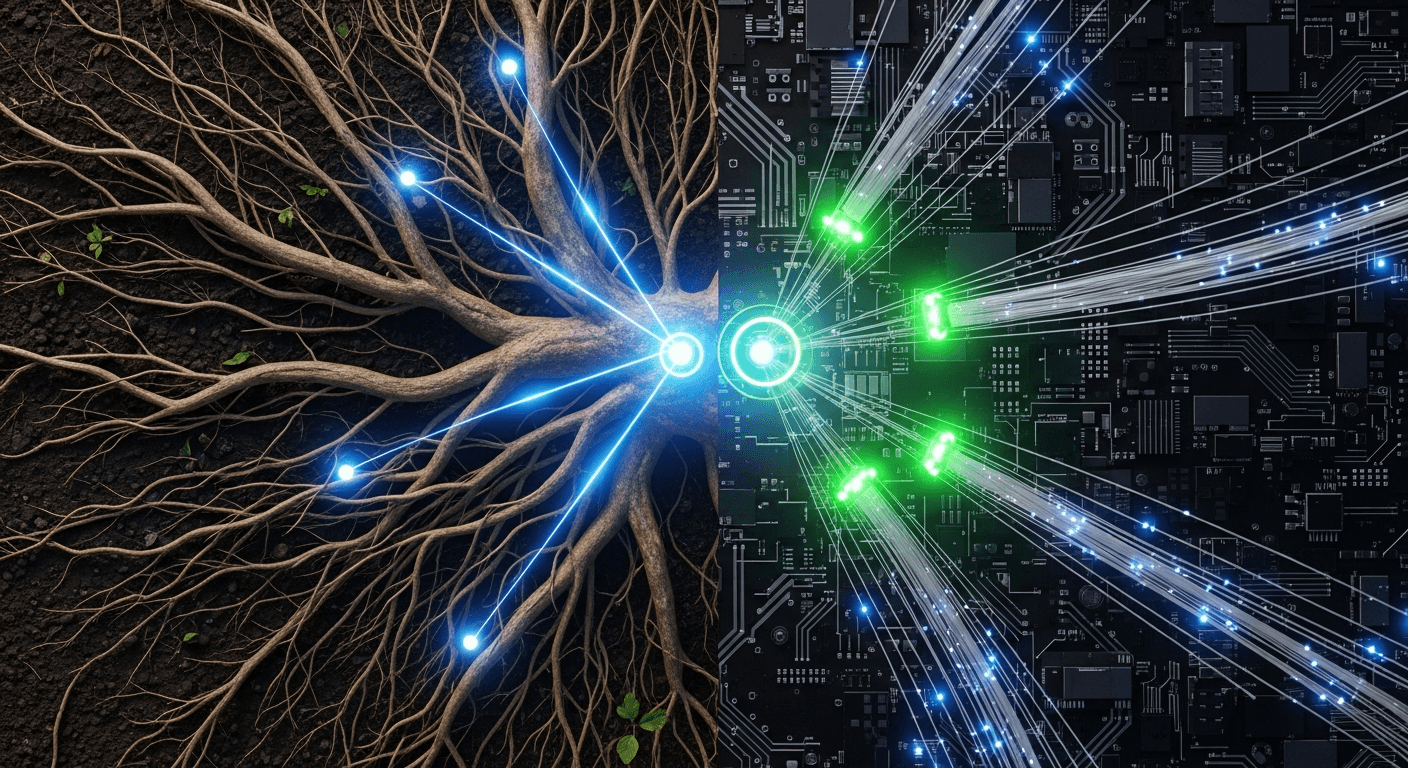
The Underground Network Nobody Told You About
There is a network running under every forest you have ever walked through. You cannot see it. You cannot hear it. But it is moving carbon, water, nitrogen, and chemical signals between trees right now, while you are reading this. It is not the internet. But it solves some of the same problems.

Justin Angeles
· 4 min read
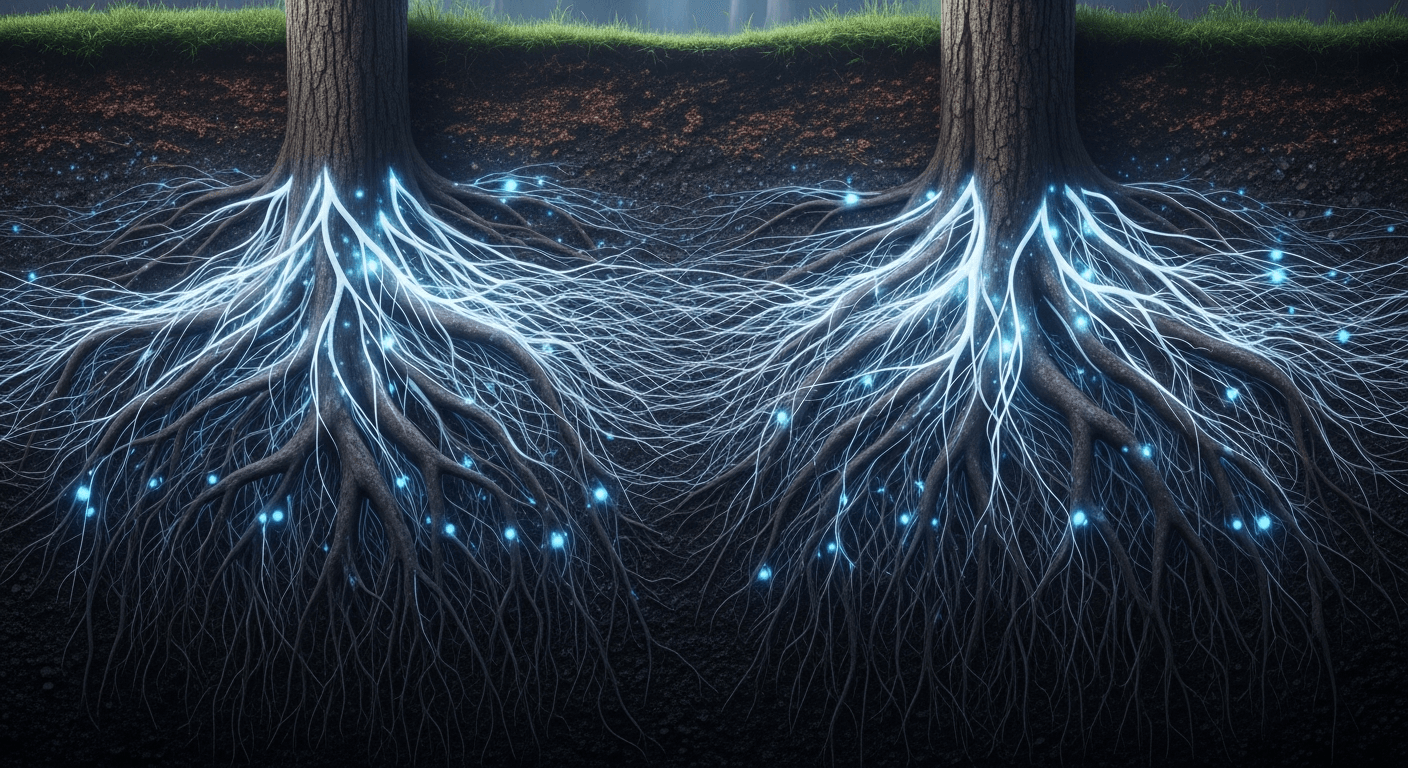
There is a network running under every forest you have ever walked through. You cannot see it. You cannot hear it. But it is moving carbon, water, nitrogen, and chemical signals between trees right now, while you are reading this.
It is not the internet. But it solves some of the same problems.
What Mycorrhiza Actually Means
The word breaks down to "fungus-root." It describes a relationship so old it predates most of the species we would recognize as trees.
In a mycorrhizal symbiosis, plant roots get colonized by fungi whose microscopic filaments, called hyphae, extend far beyond what roots can reach on their own. Roots are thick. Hyphae are thin enough to access soil pores and mineral surfaces that roots just cannot get to. The fungus dramatically increases the plant's underground reach.
In exchange for that access, the plant feeds the fungus.
The plant fixes carbon aboveground through photosynthesis. The fungus forages belowground for phosphorus, nitrogen, micronutrients, and water. Both sides need what the other produces. That makes it a genuine two-way trade, not just one organism leeching off the other.
One number that helps you feel the scale: plants commonly allocate 10% to 30% of the carbon they fix to their fungal partners. That is not a rounding error. That is a major portion of a plant's energy budget, spent maintaining the relationship.
Two Types Worth Knowing
Most of the research on forest networks focuses on two broad forms.
Arbuscular mycorrhizae (AM) are the ancient ones. They associate with the majority of land plants, including most crops and grasses. These symbioses date back hundreds of millions of years, probably to when plants first colonized land.
Ectomycorrhizae (ECM) are younger in evolutionary terms but dominate the forest types most people picture when they think "forest." Pines, firs, birches, beeches, and oaks are all ECM hosts. These fungi form a sheath around root tips rather than penetrating inside the root cells.
The distinction matters because ECM and AM forests behave differently. They store carbon differently. They respond to disturbance differently. They shape soil differently. Calling them the same thing is like calling a river and an irrigation canal the same because both move water.
The Network Emerges
Here is where it gets interesting.
When one fungal individual colonizes multiple plant root systems at the same time, you get what ecologists call a common mycorrhizal network, or CMN. The fungus becomes a physical bridge between separate plants.
At that point, resources do not just move from soil to plant. They can move from plant to fungus to plant. Carbon fixed by one tree can end up in a neighbor. Water absorbed by one root system can redistribute elsewhere. Chemical signals from one plant can reach another without going through the air. Plants have their own wireless or "rootless" communication systems as well. Wi-Fi so to speak, but that is for another article.
That is the wood wide web. Not a metaphor exactly. A structural reality.
But it requires some discipline to describe accurately. The network does not mean every tree is constantly feeding every other tree through fungal charity. The fungus itself retains a significant share of what moves through it. In one six-day isotope tracing study with Douglas-fir seedlings, 26.8% of the labeled carbon that moved belowground ended up in the system, and fungal lipids accounted for 60% to 70% of the enriched material. The fungi are not passive cables. They are active participants taking a cut.
Think of them less like fiber optic lines and more like an ISP that builds the infrastructure, routes the traffic, and charges for the service.
Why This Matters Beyond Being Fascinating
The mycorrhizal network is not a curiosity. It is infrastructure.
Seedling establishment in many forests depends on it. Young trees connecting into existing networks get access to nutrients they could not acquire on their own. Old trees connected to the same network can influence how resources flow to established seedlings.
Forest resilience under stress, the ability to survive drought, shade, pathogen attack, and disturbance, is partly a function of this underground system. Remove the network and you have a collection of individual trees competing in isolation. Keep the network intact and you have a system with more degrees of freedom.
That is why the comparison to the internet is not just a catchy headline. Both systems solve a fundamentally similar problem: how do you coordinate resource distribution across a large, decentralized collection of nodes without a central controller?
Forests found one answer 400 million years ago. We found a silicon version of it about 50 years ago.
Sources
- Pickles, B. J. et al. "Transfer of 13C between paired Douglas-fir seedlings reveals plant kinship effects and uptake of exudates by ectomycorrhizas." New Phytologist 214(1), 400-411 (2017). (opens in new tab)
- Simard, S. W. et al. "Mycorrhizal networks: mechanisms, ecology and modelling." Fungal Biology Reviews 26(1), 39-60 (2012). (opens in new tab)
- Kiers, E. T. et al. "Reciprocal rewards stabilize cooperation in the mycorrhizal symbiosis." Science 333(6044), 880-882 (2011). (opens in new tab)
Part of the Wood Wide Web series. Next: The Woman Who Found the Forest's Hidden Hubs.