Suzanne and the Forest's Hidden Hubs
Suzanne Simard's 1997 experiment changed how ecologists think about trees. Not because forests are sharing economies. Because they have hubs.

Justin Angeles
· 5 min read
In 1997, Suzanne Simard published a paper in Nature that ecologists argued about for years. Not because the finding was vague. Because it was too specific to ignore.
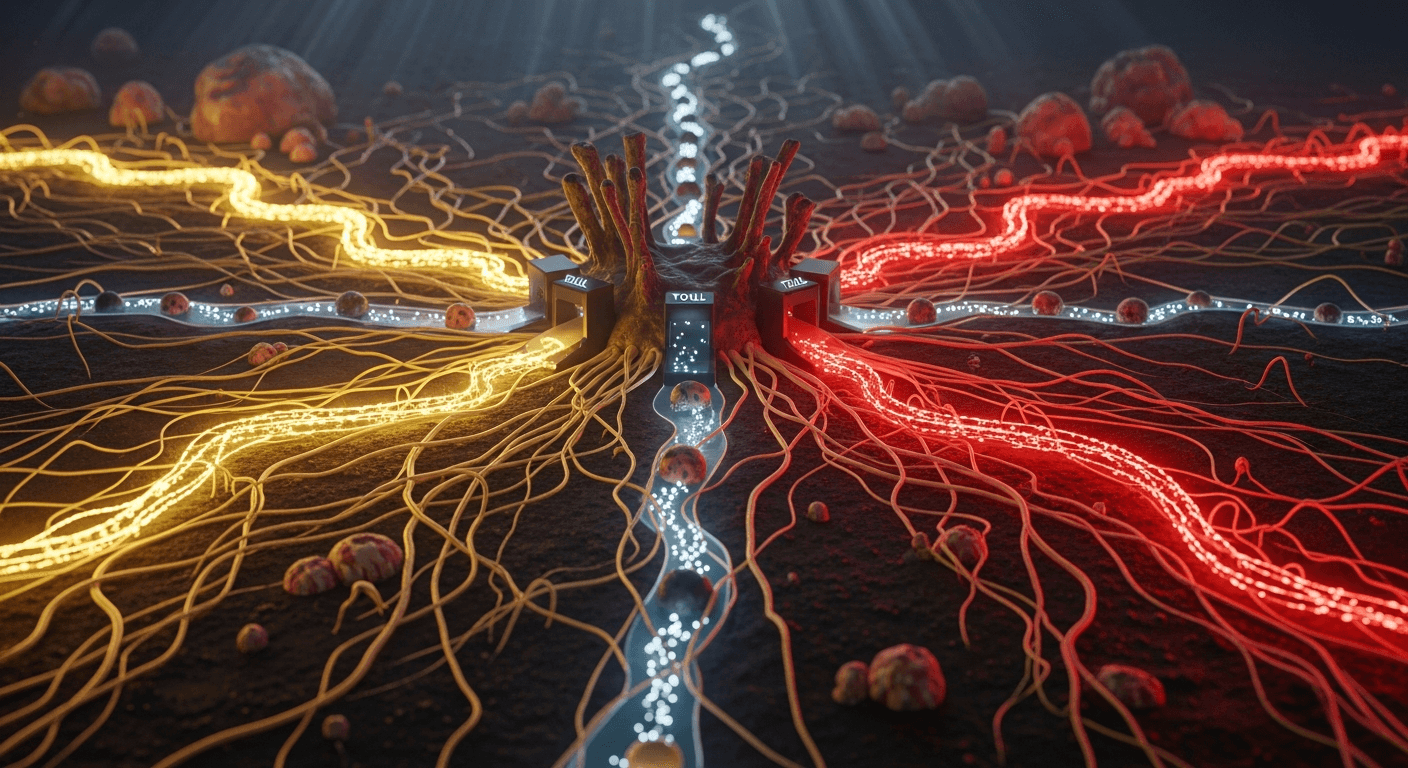
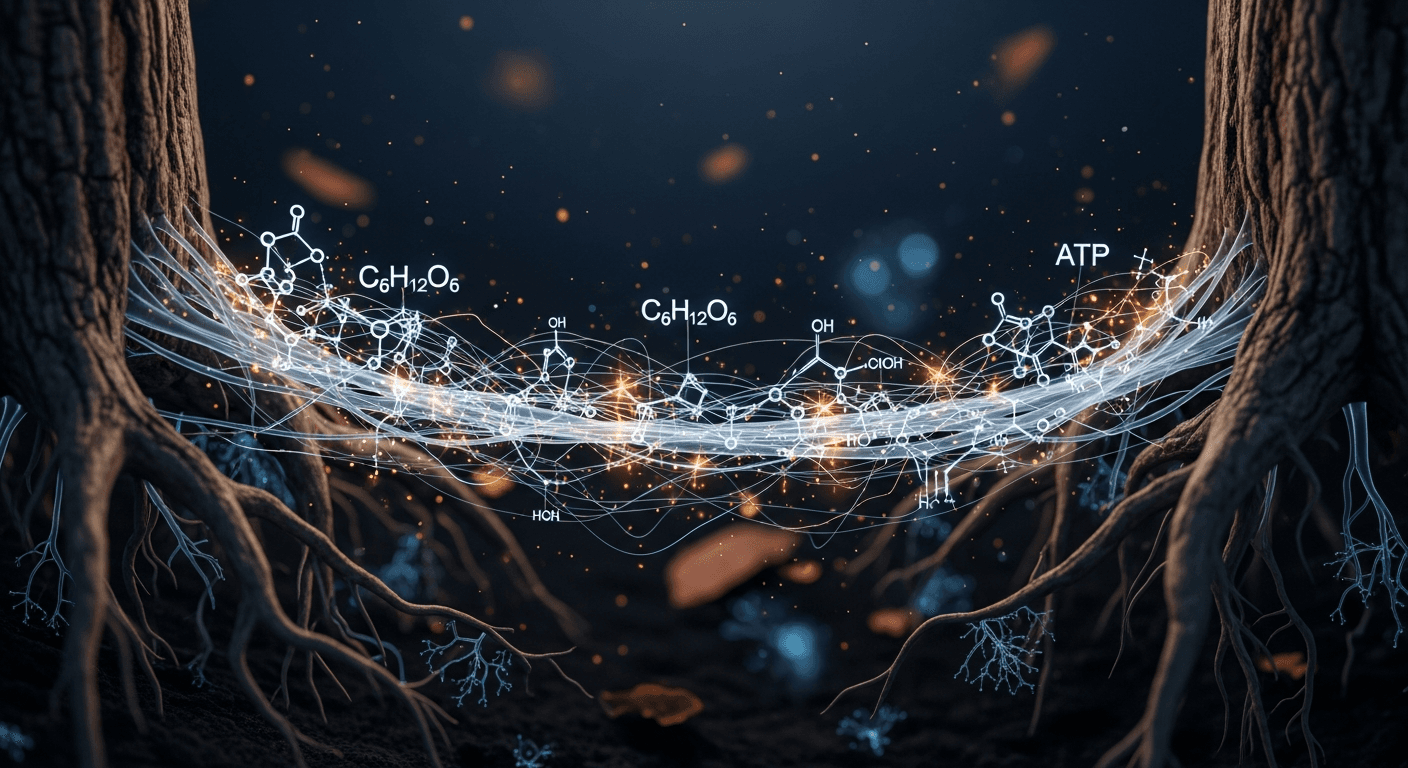
She tracked carbon moving underground between paper birch and Douglas-fir. Different species. No direct root contact. Carbon flowing from one tree to another through a shared fungal network. In one of the cleaner results from the study, Douglas-fir seedlings received up to 4.7% of the carbon fixed by neighboring birch.
4.7% doesn't sound like much. But that number is not zero, and the mechanism was real. That changed everything.
What Simard Actually Found
The study used isotopic labeling. Simard tagged birch with carbon-14 and fir with carbon-13, two different isotopes she could track separately. Then she looked to see if either showed up where it shouldn't be.
It did. Carbon moved in both directions. And the direction shifted with season. When Douglas-fir was shaded and carbon-limited, birch became a net donor. When seasonal conditions changed, the relationship adjusted.
That is not what people expected to see. Trees were supposed to be competing. Individual organisms fighting over light, water, and space. The textbook image. And that's true, they do compete. But underneath, the same trees were also exchanging carbon through belowground fungal links.
The public story simplified this into "trees are talking." That framing is easy and wrong. The more accurate version is less poetic and more interesting: the fungal network created a physical pathway for carbon to move between photosynthetically asynchronous organisms, and the direction of transfer tracked demand.
That is a systems story. Not a friendship story.
Then Came the Network Maps
Simard's carbon work raised a follow-up question nobody had good data on. If carbon can move between trees through shared fungi, what does that network actually look like? Who's connected to whom? Are some trees more connected than others?
In 2010, a team including Simard's collaborators published an answer.
Kevin Beiler and colleagues mapped ectomycorrhizal connections in interior Douglas-fir forest using Rhizopogon fungal species. They could identify individual fungal genets, meaning they could trace which trees were linked through which specific fungi. Then they ran graph analysis.
What they found looked like a real network. Not just a tangle. A structured one.
- A small number of trees and fungal individuals were highly connected.
- Most nodes had few connections.
- Path lengths through the network were short relative to network size.
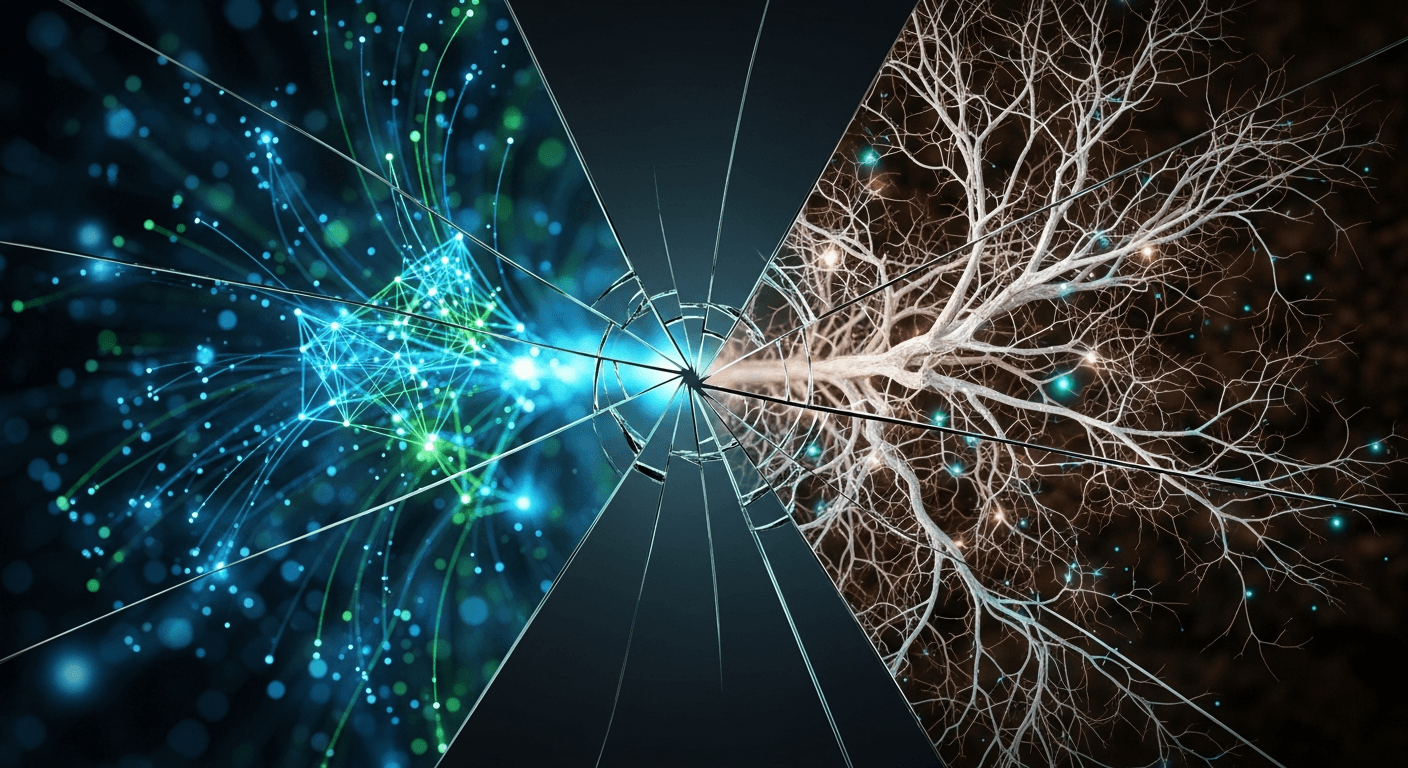
- The structure matched patterns seen in power grids, social networks, and the internet.
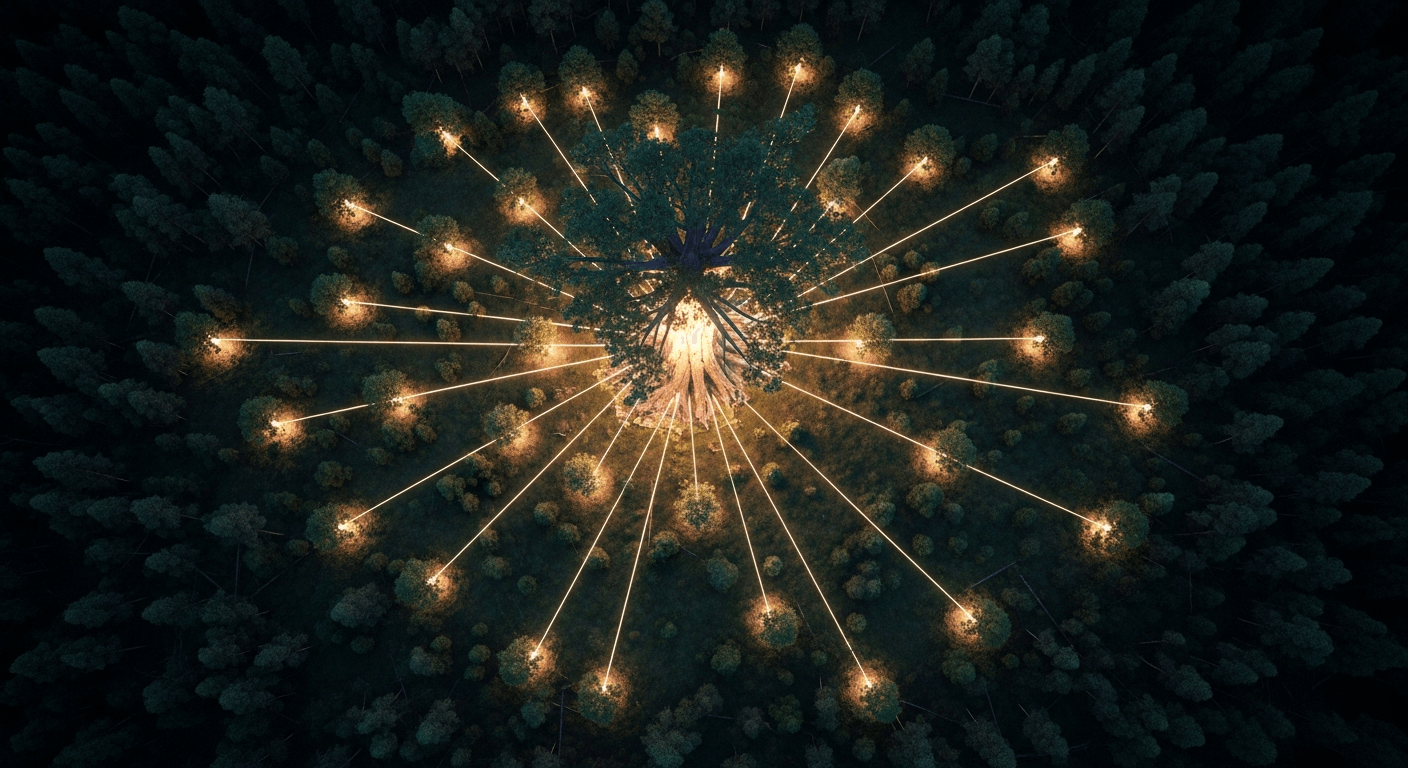
One fungal genet linked up to 19 trees. One 94-year-old Douglas-fir connected through 11 different fungal genets to 47 other trees. That is the closest thing the forest ecology literature has to a backbone node. A router.
That's where the "mother tree" concept comes from when it's used precisely. Not mystical elder wisdom. A high-degree node.
The Hub Effect
The concept of hub nodes exists in network science for a reason. Hubs do more than hold their local connections. They shape the overall network. In the Beiler data, the connected old tree wasn't just passing resources to 47 neighbors. It was sitting at the center of the network in a way that shortened paths between other trees that might never directly touch.
This is why losing old trees isn't just a biomass loss. In a network where a handful of high-degree nodes hold most of the connectivity, removing one hub can fragment the system. Paths that used to be two hops become five. Or they break entirely.
Simard's later research on regeneration dynamics tracked what happened when seedlings established near hub trees versus at the periphery of the network. Hub trees facilitated seedling establishment. Not through intention. Through connectivity. Being plugged into the main network meant more fungal partners, more carbon pathways, more resource access during the vulnerable early period.
That's a testable, structural argument. And it holds up.
Where the Story Got Away from the Science
Here's the part Simard herself would want said clearly.
The mother tree story got away from the data in public culture. By the time it reached TED talks and popular books and the documentary, forests had become communities of caring elder trees nurturing their children through an underground internet of generosity. That version is not accurate.
In 2023, Judith Karst and colleagues published a detailed analysis in Nature Ecology & Evolution arguing that common mycorrhizal network research had suffered from positive citation bias and over-interpretation. Studies finding effects got cited. Studies finding no effect got passed over. The accumulated literature looked more positive than the full evidence base warranted.
That critique matters. The science is solid. The hub structure is real. Cross-species carbon transfer happens. But the broad version, forests as altruistic sharing networks with wise elder matriarchs, is a narrative overlay, not a finding.
The rigorous version is still striking. Forests have distributed network architecture with identifiable hub nodes. Old trees are disproportionately central to that architecture. Their removal has measurable effects on connectivity and regeneration. The network facilitates transfer, though whether that transfer is "aid" or just gradient-driven flow through shared infrastructure is context-dependent and contested.
Why This Matters Anyway
The reason Simard's work stuck is not just the carbon number. It's that it forced a systems perspective into a field that had been dominated by individual-organism thinking.
You can't understand a network by studying nodes in isolation. You can't understand a forest by studying individual trees. The ectomycorrhizal connections don't just add up. They create emergent structure. Hub effects. Redundancy. Path-dependent dynamics. That's the insight that changes how ecologists think about forest management, regeneration, climate resilience, and what we're actually losing when we cut old growth.
Simard found a hub. The forest had been running one for 400 million years before anyone thought to measure it.
Sources
- Simard, S. W. et al. "Net transfer of carbon between ectomycorrhizal tree species in the field." Nature 388, 579-582 (1997). (opens in new tab)
- Beiler, K. J. et al. "Architecture of the wood-wide web: Rhizopogon spp. genets link multiple Douglas-fir cohorts." New Phytologist 185(2), 543-553 (2010). (opens in new tab)
- Karst, J., Jones, M. D., and Hoeksema, J. D. "Positive citation bias and overinterpreted results lead to misinformation on common mycorrhizal networks in forests." Nature Ecology & Evolution 7, 547-556 (2023). (opens in new tab)
Part of the Wood Wide Web series. Previous: The Underground Network Nobody Told You About. Next: Why Forest Networks and the Internet Have the Same Shape.