Series · 12 parts
The Wood Wide Web
How trees secretly connect through underground fungal networks, and what happens when scientists, hackers, and climate change discover the same hidden web.
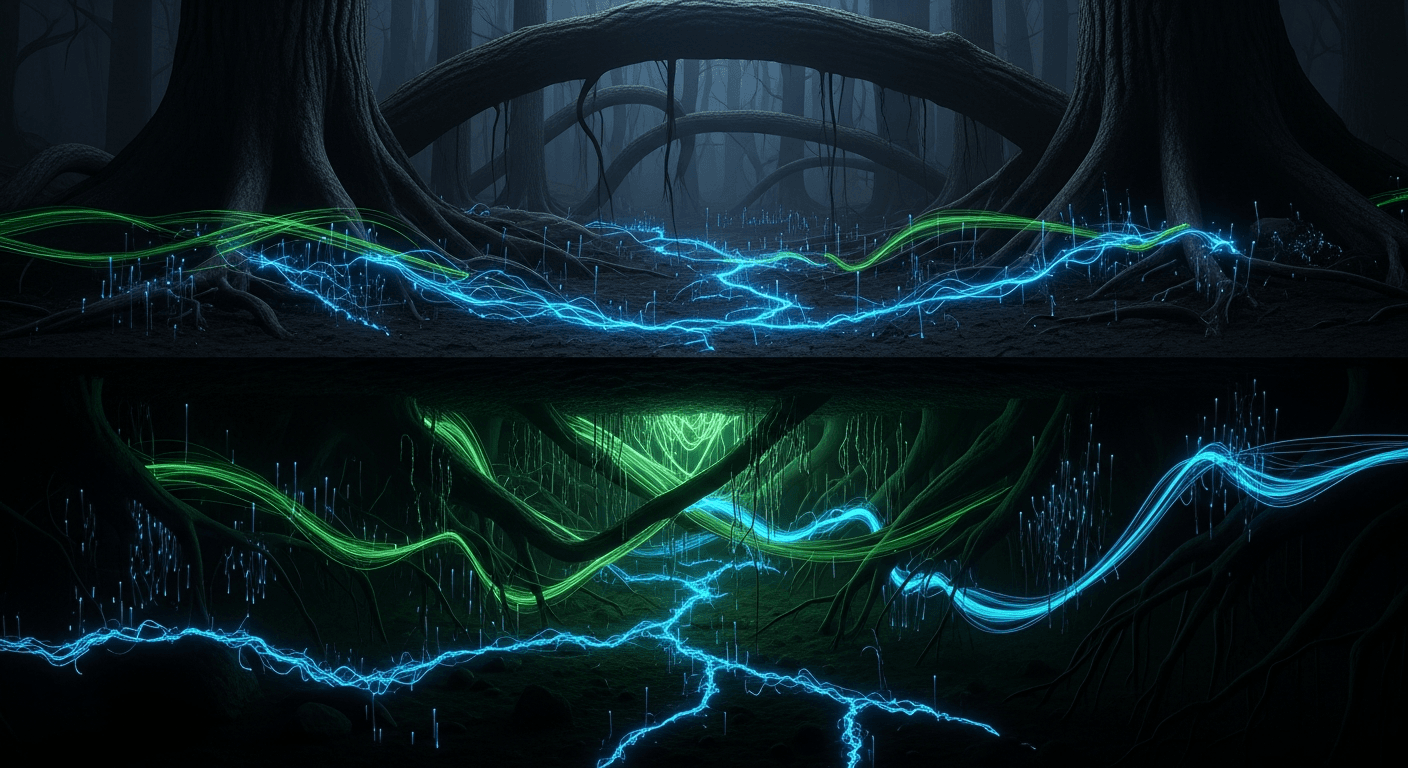
The Wood Wide Web
You've been walking over it your whole life. Beneath every forest floor, tangled among the roots of every tree, there's a living network so vast and complex it makes the internet look like a hobby project. It connects trees across distances that would make a fiber-optic engineer sweat. It moves resources, sends distress signals, and reshapes entire ecosystems, and it's been doing all of this for hundreds of millions of years, long before anything with a brain even existed.
This twelve-part series digs into the science, the mythology, and the boundary-pushing tech that has emerged from our growing understanding of underground fungal networks. You'll meet the researcher who discovered that forests have hubs and spokes like airports. You'll learn why calling trees "generous" might be one of the biggest misunderstandings in ecology. And you'll find out why someone is already building computers out of mushrooms. It's a story about what happens when we stop looking at trees as individuals and start seeing the system they're plugged into, and what that system might be able to teach us about our own networks, our own technologies, and maybe even our own intelligence.
In this series
- 01The Underground Network Nobody Told You AboutThere is a network running under every forest you have ever walked through. You cannot see it. You cannot hear it. But it is moving carbon, water, nitrogen, and chemical signals between trees right now, while you are reading this. It is not the internet. But it solves some of the same problems.4 min read
- 02Suzanne and the Forest's Hidden HubsSuzanne Simard's 1997 experiment changed how ecologists think about trees. Not because forests are sharing economies. Because they have hubs.5 min read
- 03Why Forest Networks and the Internet Have the Same ShapeNodes, edges, hubs, redundancy, adaptive routing. Both systems evolved the same architecture independently. That's not a metaphor. That's convergent engineering.4 min read
- 04Trees Don't Actually Talk... Or Do They?Plants exchange defense signals, carbon, and possibly electrical spikes through shared fungal networks. It's not language. But it's not nothing either.4 min read
- 05Different Species, Same NetworkBirch and Douglas-fir share the same fungal infrastructure despite being different species. The carbon flows between them like load balancing, not charity.4 min read
- 06A Marketplace - Not a Charity, The Reality of NatureThe wood wide web story got away from the science. Forests have cooperation and competition. Fungi are economic actors. Kin effects are real but small. Here's what the data actually says.5 min read
- 07The Network That Predates TreesMycorrhizal symbiosis is 400 million years old. It may have helped plants colonize land in the first place. Humans built something similar in about 50 years.4 min read
- 08Is a Forest Smart? It Depends What You Mean by Smart.Forests sense, adapt, and produce coordinated behavior without a central brain. That's not consciousness. But it might be a form of distributed computation worth taking seriously.4 min read
- 09Science Caught Up to Something Many Cultures Already KnewWestern ecology is excited about forest networks. Many Indigenous knowledge systems never needed the metaphor. They've been describing relational ecology for a long time.5 min read
- 10Climate Change Has a Target UndergroundMycorrhizal networks are infrastructure. Climate change is stressing them in four distinct ways. The consequences reach all the way to how forests store carbon.5 min read
- 11Someone Is Building Computers out of MushroomsResearchers are using living fungal networks as sensing and computing substrates. They've already steered robots with mycelium. Here's what the frontier actually looks like.4 min read
- 12Where the Wood Wide Web Analogy Holds and Where It Falls ApartThe forest-as-internet comparison is useful and overused. Here's a precise breakdown of which parts are accurate, which are misleading, and what the comparison actually adds.5 min read