Different Species, Same Network
Birch and Douglas-fir share the same fungal infrastructure despite being different species. The carbon flows between them like load balancing, not charity.

Justin Angeles
· 4 min read
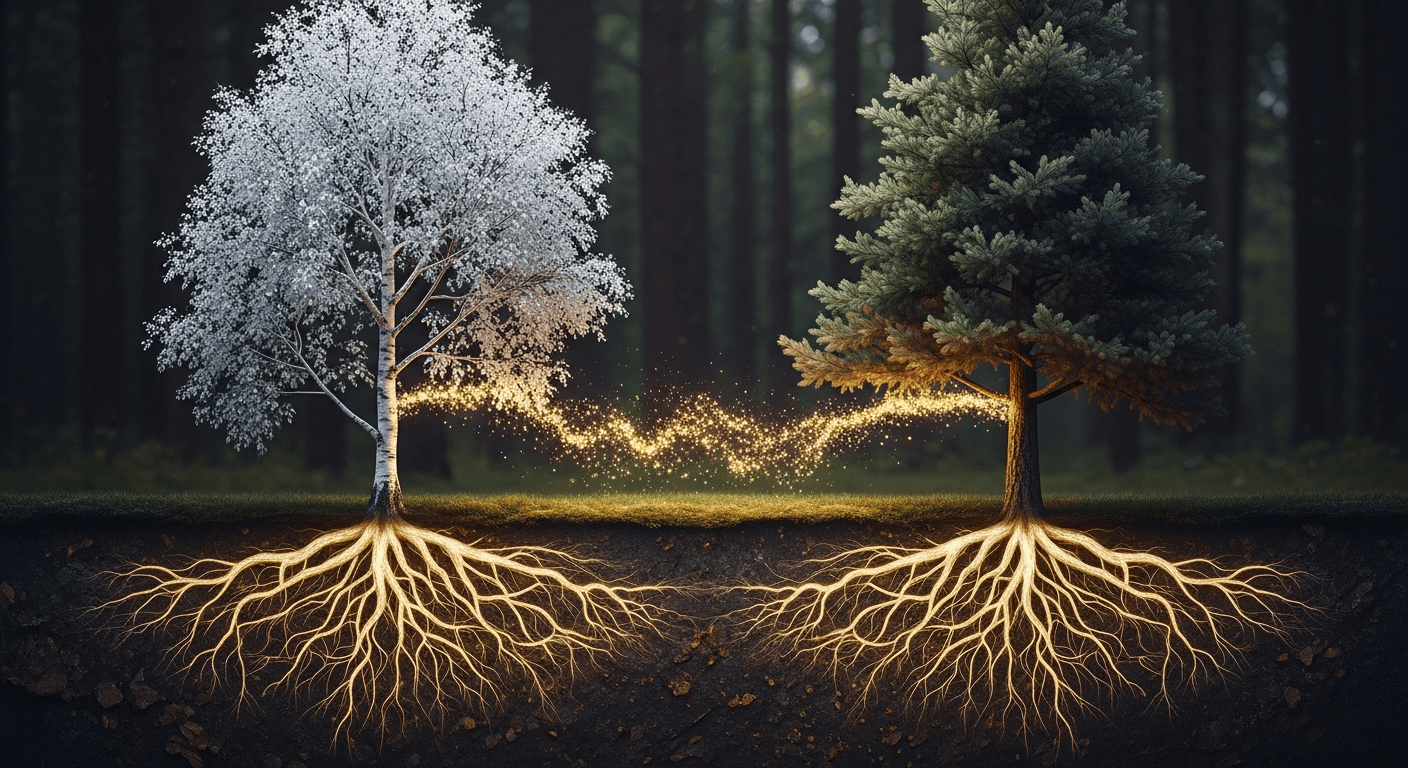
Paper birch and Douglas-fir don't have much in common above ground.
Birch is a broadleaf, fast-growing, early successional. It colonizes disturbed ground quickly, fills light gaps, drops its leaves in fall. Douglas-fir is a long-lived conifer. Slower, denser, shade-tolerant. The two species often grow near each other in Pacific Northwest forests, but they occupy different ecological roles and don't look like obvious partners.
Underground, they're on the same network.
The 1997 Experiment
Suzanne Simard's landmark study tracked carbon moving between these two species in real forest conditions. She used two carbon isotopes, carbon-13 and carbon-14, to tag the trees separately. Then she watched to see if either isotope showed up where it shouldn't.
It did. Carbon moved from birch to fir through belowground fungal connections. Up to 4.7% of the carbon fixed by birch ended up in Douglas-fir seedlings nearby. That number shifted with context. When Douglas-fir was shaded and carbon-limited, birch became a net supplier. When conditions changed, so did the direction of flow.
The finding that made this more than a curiosity: the transfer tracked demand. When fir needed carbon and birch had surplus, carbon moved toward fir. The network didn't just enable connection. It enabled responsive allocation between fundamentally different organisms.
Why Different Species on One Network
The typical mental model of a symbiotic network is species-specific. This organism works with that one. Mutual exclusivity. What the birch-fir example shows is that some fungi connect across species lines, and when they do, resources can flow between trees that have no other direct relationship.
This happens because ectomycorrhizal fungi don't strictly specialize by host species. A fungal genet can colonize both birch and fir root systems. Once it does, it creates a physical pathway between them. What moves through that pathway depends on source-sink dynamics, who has more, who needs more, and where the fungus itself is growing.
The network analogy holds well here. Think of birch and fir as different device types on the same infrastructure. A laptop and a server are different hardware classes with different roles. They don't operate identically. But they can communicate and share resources through shared network infrastructure.
Birch and fir are running on shared fungal infrastructure. One might be a strong carbon source in summer while the other is shaded. The same network that connects them lets them function as asynchronous producers, each contributing when it can, each drawing when it needs to.
Load Balancing, Not Charity
The framing that gets people into trouble is the altruism narrative. Birch isn't helping fir because birch is generous. Birch is a stronger photosynthetic source in certain conditions, and the fungal network moves carbon down concentration gradients.
This is worth saying directly because the "trees share to help each other" story is appealing but fragile. It doesn't survive the scrutiny it invites.
What survives scrutiny is a resource allocation story. Two species with different seasonal rhythms and light-response curves, connected by a fungal network that redirects surplus toward deficit. The result looks cooperative. The mechanism is gradient-driven.
That's actually more interesting than altruism. Altruism is a human concept that requires intention. What forests demonstrate is that useful resource distribution can emerge from a network of self-interested nodes following local rules.
The fungus is not neutral in this. It retains a significant share of what flows through it. It is not a charity pipeline. It's an economic actor that happens to connect two different tree species, and in doing so creates the physical conditions for transfer.
What Mixed-Species Networks Mean for Forests
The birch-fir cross-species connection has implications beyond the biology of those two trees.
If species diversity increases the variety of source-sink relationships on a shared fungal network, then mixed forests may be more resilient than monocultures. Different species respond differently to drought, shade, temperature, and seasonal variation. A network connecting diverse species has more opportunities to redirect resources toward nodes that currently need them.
This is one reason ecologists point to mixed-species forests as more climate-resilient than plantations. Not just because genetic diversity hedges against species-specific pathogens. Also because network-level resource sharing is more active and responsive in a diverse system.
One important caveat: the cross-species transfer documented in birch-fir systems is not universal. It depends on specific fungal species that happen to colonize both hosts. Not every pair of neighboring trees is sharing a network. Not every shared network produces significant transfer. The Simard result is a real documented phenomenon with clear mechanistic underpinning. It is not proof that all forests are constantly redistributing carbon across all species.
The Bigger Point
What the birch-fir example actually demonstrates is that forest communities can have integration properties you wouldn't predict by studying individual trees in isolation.
The productive unit isn't always the individual tree. Sometimes it's the mycorrhizal cluster. Sometimes it's the set of species sharing a single fungal genet. The boundary of the relevant system is underground, not visible, and not obvious from species composition alone.
Forests have hidden structure. The connectivity patterns underground don't map to the species patterns you see above ground. And those hidden patterns shape what survives, what regenerates, and how the whole system responds to stress.
Cross-species sharing through fungal networks is part of that hidden structure. It's real. It's measured. And it changes what a forest is.
Sources
- Simard, S. W. et al. "Net transfer of carbon between ectomycorrhizal tree species in the field." Nature 388, 579-582 (1997). (opens in new tab)
- Simard, S. W. et al. "Mycorrhizal networks: mechanisms, ecology and modelling." Fungal Biology Reviews 26(1), 39-60 (2012). (opens in new tab)
- Bennett, J. A. et al. "Plant-soil feedbacks and mycorrhizal type influence temperate forest population dynamics." Science 355(6321), 181-184 (2017). (opens in new tab)
Part of the Wood Wide Web series. Previous: Trees Don't Talk. They Do Something More Interesting.. Next: Forests Are Not a Sharing Economy.