The Network That Predates Trees
Mycorrhizal symbiosis is 400 million years old. It may have helped plants colonize land in the first place. Humans built something similar in about 50 years.

Justin Angeles
· 4 min read
The internet is about 50 years old if you're counting from ARPANET. The fungal networks underneath forests are roughly 400 million years old.
That gap matters. Not as a way to make the internet feel young, but as a way to understand what kind of solution mycorrhizal networking actually is. It's not a curiosity. It's one of the most tested architectures in the history of life.
The Rhynie Chert
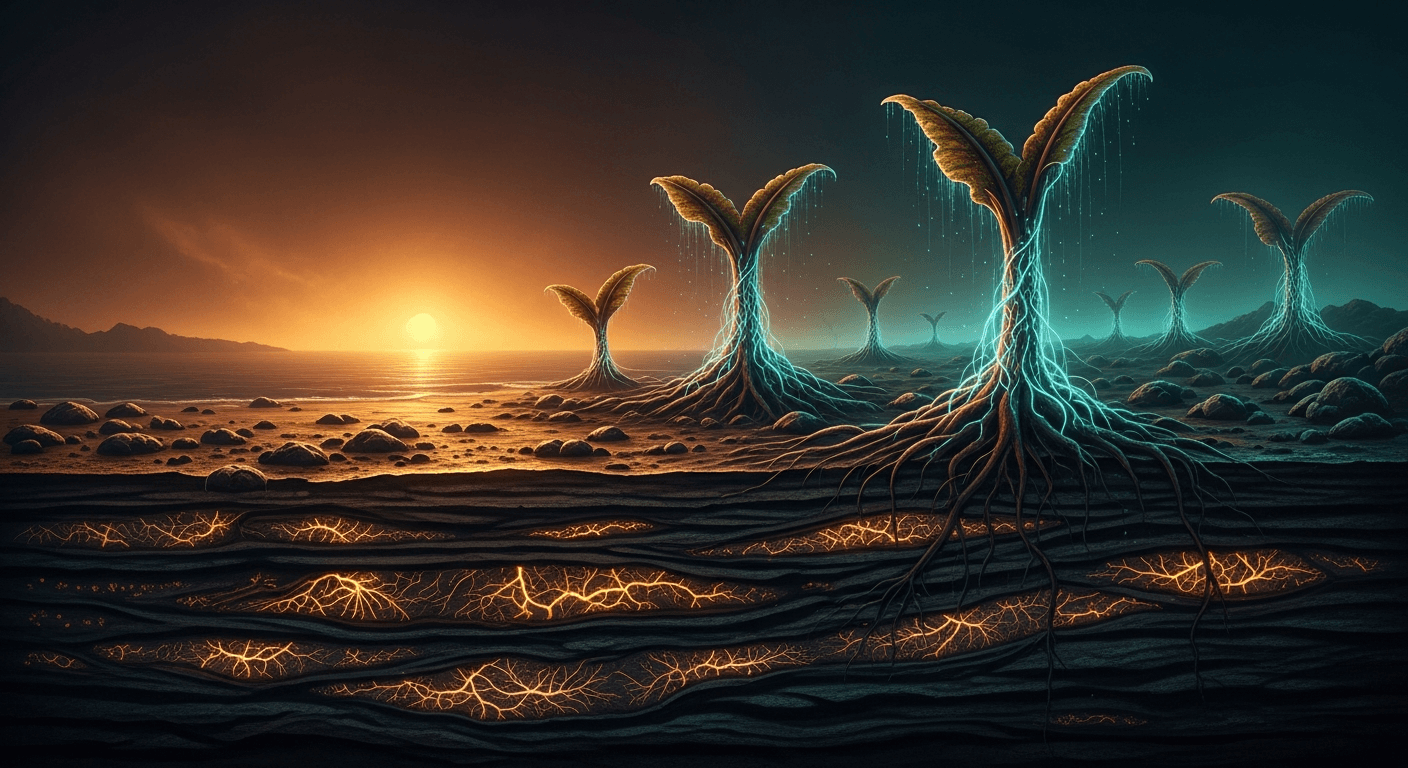
In Scotland, near a village called Rhynie, there is a deposit of silicified rock called the Rhynie chert. It's approximately 407 million years old, from the Early Devonian period. And it contains some of the most detailed plant fossils on record.
Among those fossils are structures that look unmistakably like arbuscular mycorrhizae. Fungal hyphae penetrating plant cells, arbuscules, the tree-like internal structures that mark the site of nutrient exchange, all preserved in the rock.
That means plant-fungal symbiosis was already established before most trees existed. Before most land animals. Before the Carboniferous forests that would eventually become the coal we burn.
In 1994, Winfried Remy and colleagues described these structures formally and placed the origin of mycorrhizal symbiosis at or before 407 million years ago. Later analyses have pushed the estimate back further, with some molecular clock studies suggesting the association began more than 450 million years ago, around the time plants first colonized land.
The Enabling Technology
Early land plants had a problem. Terrestrial soils are chemically hostile. Mineral nutrients are locked up in rock particles and organic matter that roots can't access directly. Water doesn't move the way it does in aquatic environments. The soil surface is physically harsh.
Fungi don't have those limitations in the same way.
Fungal hyphae are extremely thin, somewhere between 2 and 10 micrometers in diameter. They can penetrate spaces that roots can't reach. They produce enzymes that dissolve mineral compounds. They access water films in pores too small for roots. And they can extend tens of centimeters beyond the root zone, dramatically expanding the effective foraging area of the plant.
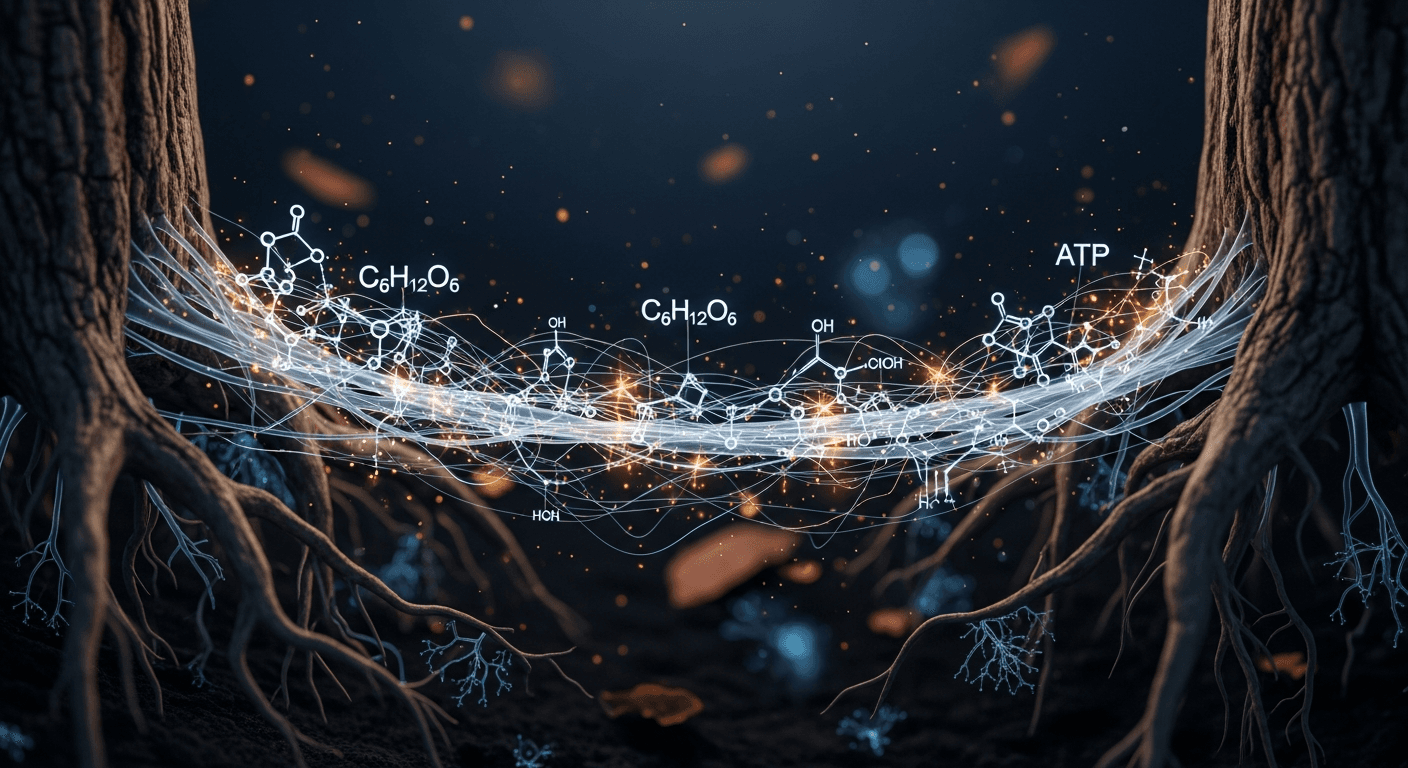
In exchange, early land plants could offer one thing fungi couldn't make themselves: sugars fixed from sunlight.
The deal was already favorable in the Devonian. Plants got nutrient access and water handling. Fungi got carbon. Both lineages survived and diversified while the partnership deepened.
Most evolutionary biologists who study this period argue that mycorrhizal symbiosis wasn't just useful to early land plants. It may have been necessary. Plants with limited root systems and limited chemical machinery for soil nutrient acquisition would have struggled badly without fungal partners.
The network helped build the terrestrial world we inherited.
400 Million Years of Iteration
The internet has gone through roughly six major architectural generations in 50 years. Every few years, fundamental assumptions about routing, addressing, and bandwidth have been revised.
Mycorrhizal symbiosis has been iterating under selection pressure for 400 million years. Every cold period, dry period, mass extinction, soil chemistry shift, host diversification, and fungal arms race has been a test. The architecture that survived all of it is the one in the soil today.
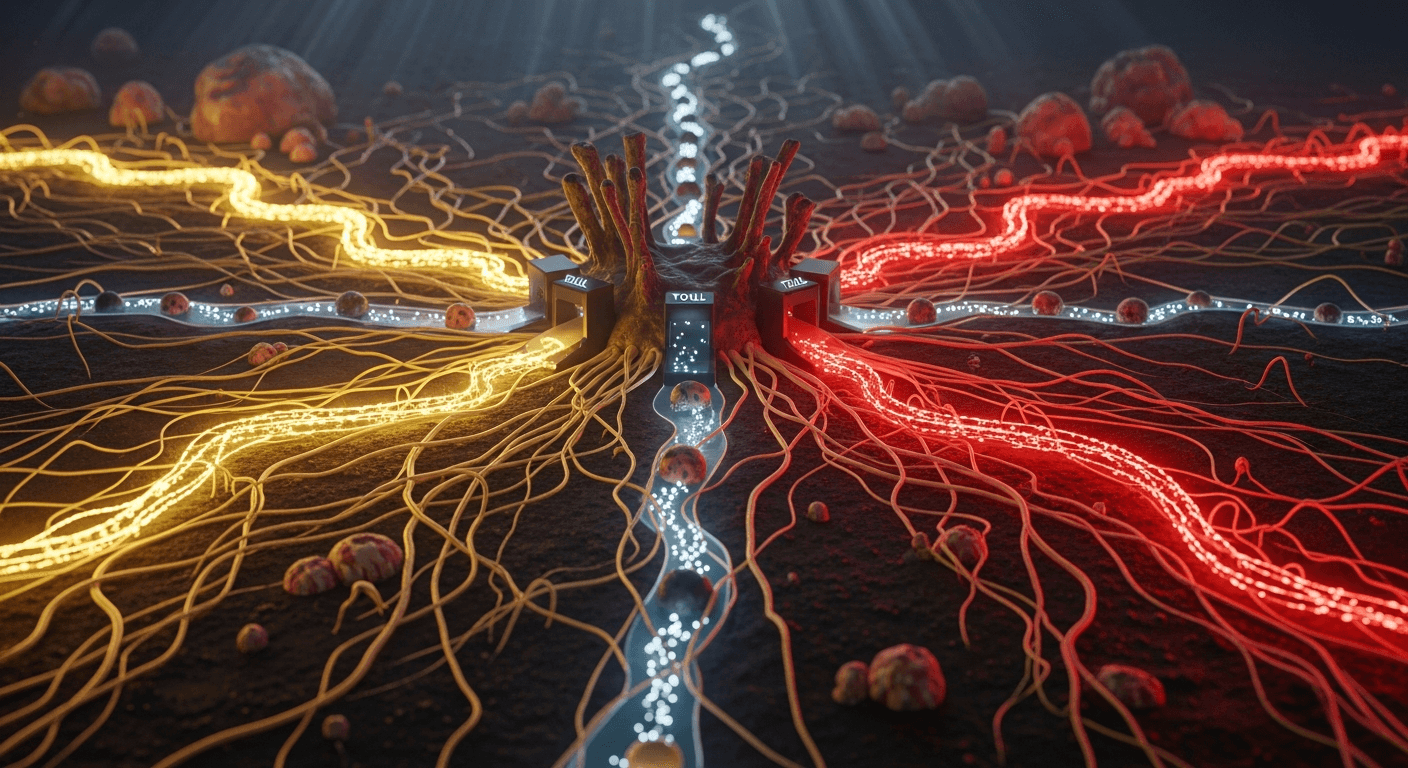
That's not a trivial fact. It means the basic principles of fungal networking, distributed connections, hub-and-spoke topologies, source-sink resource allocation, negotiated exchange, have been tested under every climate Earth has produced, with every class of land plant that has existed, across every major soil type.
Humans discovered that this architecture works well for information networks in the 1960s and 1970s. Fungi and plants already knew. They just didn't write papers about it. Or did they? Maybe that's a deeper reason to the plant fossils.
Two Types of Partnership
The 400 million year timeline contains two distinct evolutionary stories.
Arbuscular mycorrhizal fungi are the ancient ones. They associate with more than 70% of land plant species. Grasses, most crop plants, many tropical trees. Their origins trace to that Devonian symbiosis in the Rhynie chert. They penetrate plant cells directly to form those characteristic arbuscules where nutrient exchange occurs.
Ectomycorrhizal fungi are newer. They evolved multiple times independently in different fungal lineages. They associate with fewer than 5% of plant species, but those species include most of the trees in temperate and boreal forests: pines, firs, oaks, beeches, birches. Instead of penetrating cells, they wrap around root tips and extend into soil.
ECM fungi are the ones at the center of the wood wide web story. They're the networks Simard mapped, the hubs Beiler measured, the systems climate change is now threatening. They're younger than AM fungi in evolutionary terms, but they became the dominant architecture in forests that cover a large fraction of Earth's terrestrial carbon.
What the Age of the System Means
When you look at forest mycorrhizal networks through this timeline, the framing shifts.
We didn't discover that forests are connected. We discovered that an ancient, tested, deeply integrated system was operating under our feet the whole time, in a way we hadn't measured.
The internet parallel is still useful. But it's useful in the inverse direction from how it usually gets presented. We didn't invent something forests also have. We reinvented something forests had first.
And the version forests are running is 400 million years more debugged than ours.
Sources
- Remy, W., Taylor, T. N., Hass, H., and Kerp, H. "Four hundred-million-year-old vesicular arbuscular mycorrhizae." Proceedings of the National Academy of Sciences 91(25), 11841-11843 (1994). (opens in new tab)
- Tedersoo, L. et al. "Global diversity and geography of soil fungi." Science 346(6213), 1256688 (2014). (opens in new tab)
- Steidinger, B. S. et al. "Climatic controls of decomposition drive the global biogeography of forest-tree symbioses." Nature 569, 404-408 (2019). (opens in new tab)
- Simard, S. W. et al. "Mycorrhizal networks: mechanisms, ecology and modelling." Fungal Biology Reviews 26(1), 39-60 (2012). (opens in new tab)
Part of the Wood Wide Web series. Previous: Forests Are Not a Sharing Economy. Next: Is a Forest Smart? It Depends What You Mean by Smart..