Where the Wood Wide Web Analogy Holds and Where It Falls Apart
The forest-as-internet comparison is useful and overused. Here's a precise breakdown of which parts are accurate, which are misleading, and what the comparison actually adds.

Justin Angeles
· 5 min read

The "wood wide web" is one of the more successful science metaphors of the last 30 years.
It did its job. It gave a wide audience a way to understand something genuinely complex: that forests have underground fungal networks through which resources and signals move between trees. The phrase is catchy, the image is vivid, and it maps onto something people already understand.
It also caused problems.
What the Analogy Gets Right
At the structural level, the comparison holds up.
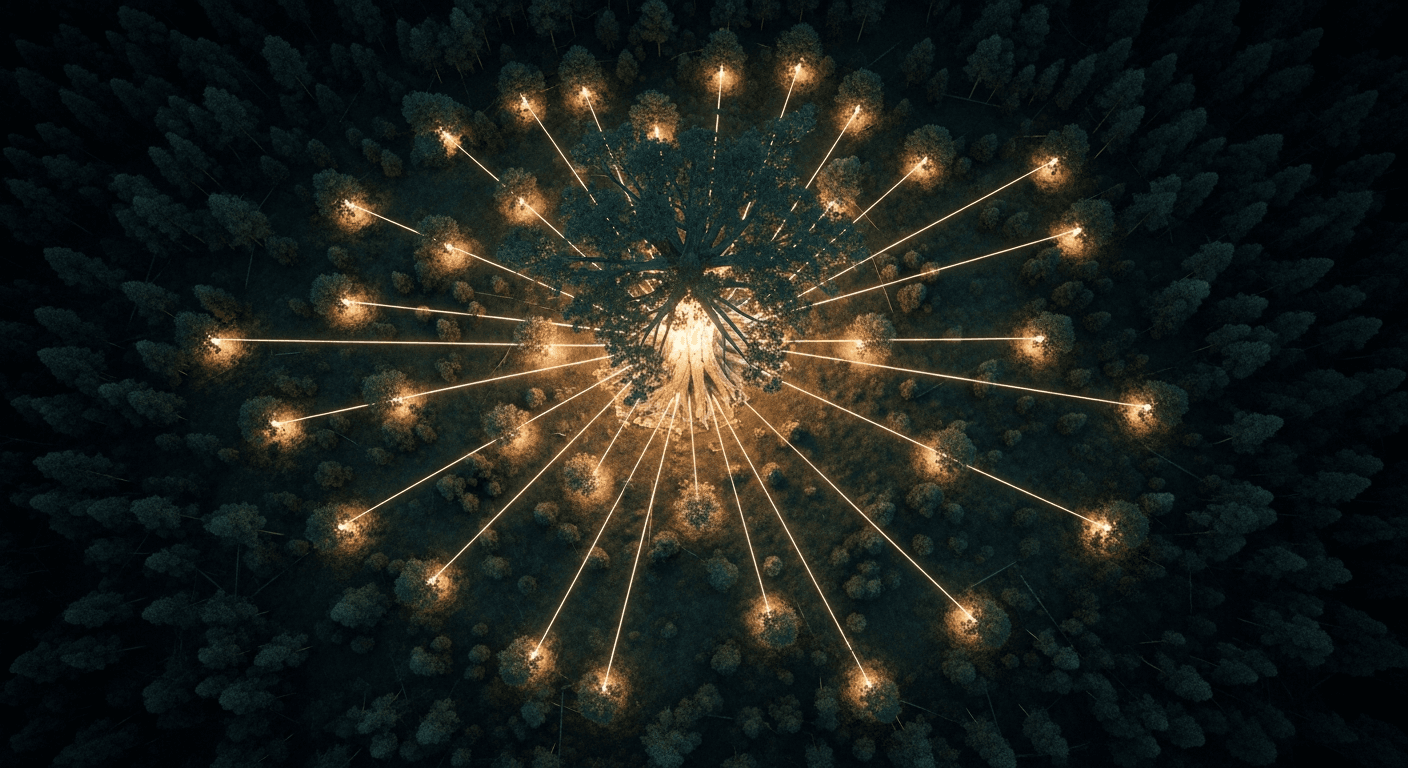
Both forests and the internet are distributed systems. Neither has a central command. Both produce coordinated behavior from local connections following local rules. In both cases, the global structure is an emergent property of how nodes connect to each other, not a plan executed from headquarters.
Both show hub-and-spoke topology. The Beiler 2010 network maps of Douglas-fir forests found scale-free, small-world structure: a few highly connected nodes, many lightly connected ones, and short average path lengths across the whole network. The internet has the same architecture. This convergence is real and reflects the physics of efficient distributed networks.
Both have redundancy built in. Multiple overlapping paths mean that losing any single connection rarely destroys the whole network. Routing finds alternatives. This is why the internet was designed the way it was: to survive node failures. Forests show the same resilience property, within limits.
Both produce emergent coordination. Trees don't instruct the network. The network doesn't instruct the trees. But connected trees can shift carbon flows, propagate defense signals, and alter each other's resource status in ways that look like coordination without anyone coordinating.
Both are vulnerable at the hubs. Random node failure is usually tolerable. Targeted removal of high-degree nodes is not. This is true for backbone internet routers and for old trees sitting at the center of mycorrhizal networks.
Those parallels are not superficial. They reflect a genuine convergence on similar solutions to similar problems: distributing resources across a large area without centralized control.
Where It Breaks
The analogy breaks in ways that matter.
No packet addressing.
Internet traffic moves in discrete, addressed packets. Each packet has a header identifying source and destination. Routers read the header and forward accordingly. The system is digital, explicit, and protocol-based.
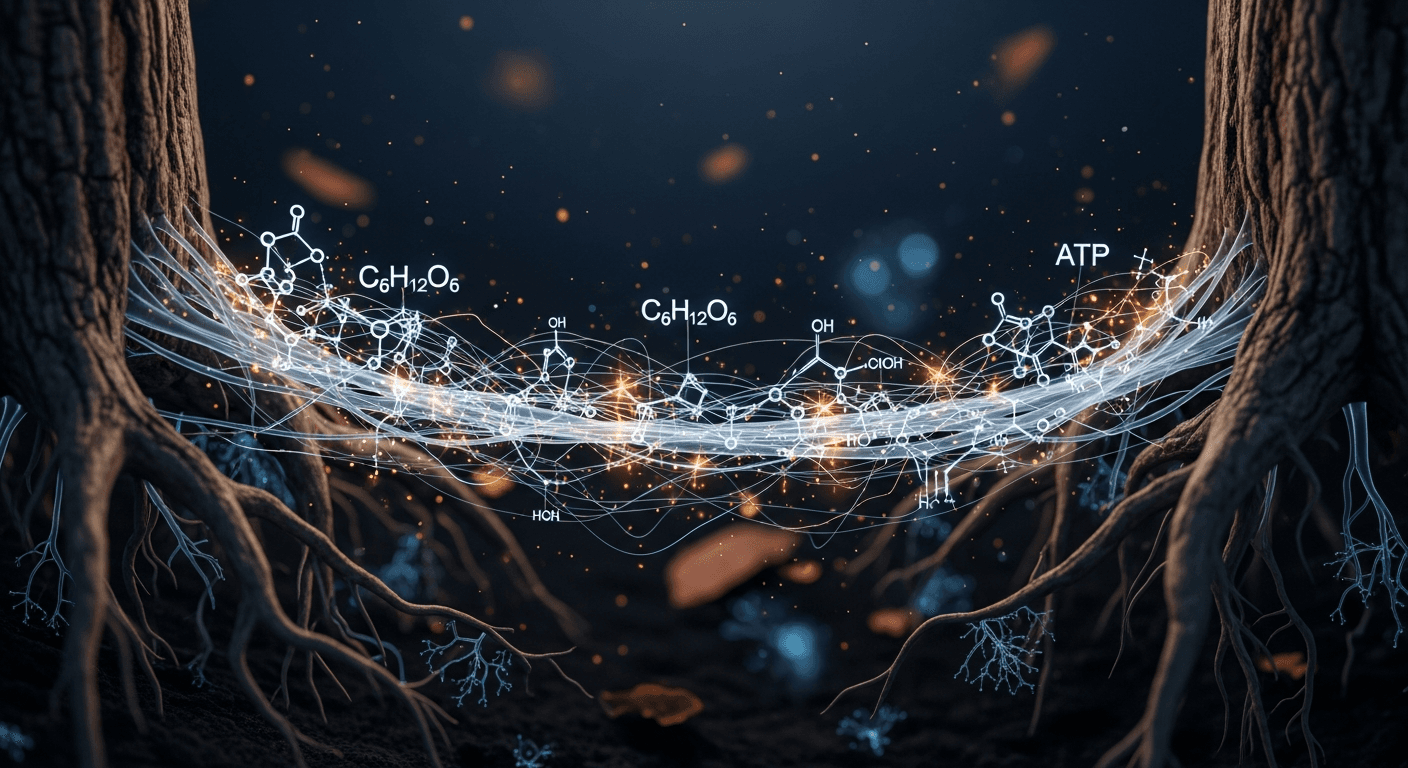
Forest networks move bulk flows down concentration gradients. Carbon moves from high to low. Phosphorus moves where fungal hyphae have scavenged it. There is no address. There is no protocol. There is no acknowledgment. A molecule doesn't know where it's going.
The forest solves a routing problem, but not through routing. It solves it through chemistry and physics.
Speed.
Internet latency is measured in milliseconds. A packet crosses the country in under 50. A carbon signal through a mycorrhizal network might take hours or days to move between neighboring trees. A defense response might propagate across a connected stand over the course of a week.
These aren't slow versions of the same thing. They're different timescale systems with different dynamics. The internet is optimized for near-instantaneous state synchronization. Forests are optimized for seasonal resource rebalancing.
The network participates.
In the internet, routers forward packets. They don't consume them. The fiber optic cable doesn't take a cut of your data. The infrastructure is passive.
Mycorrhizal fungi are not passive. In the Pickles 2017 study, 60-70% of enriched phospholipids were in fungal biomass. The network operator retains most of what flows through it. The fungi are participants, not cables.
This changes the economics of the whole system. Carbon transfer between trees is often a byproduct of fungal metabolism. The forest's "sharing" emerges from a web of self-interested organisms, not from a neutral transmission system.
Mixed incentives throughout.
Internet protocols are designed to be neutral. A router doesn't prefer some traffic over others based on what it can extract. Forest networks run on incentives. Plants reward fungal partners that deliver more nutrients. Fungi allocate preferentially to roots that pay more carbon. Partners can cheat. Partners can sanction each other.
The Kiers 2011 work showed clearly that mycorrhizal exchange is stabilized by reciprocal rewards, not by shared interest. The system cooperates because cooperation is enforced, not because the participants are aligned.
Context dependence.
Internet protocols are designed to behave consistently regardless of context. TCP works the same way in winter as summer, in Alaska as in Brazil.
Forest networks change with species composition, nutrient status, season, drought, fungal identity, relatedness between plants, light levels, and disturbance history. The same two trees connected by the same fungal species may show very different transfer dynamics depending on conditions. There is no universal behavior to predict.
The Useful Version of the Comparison
The analogy is most useful when it imports concepts rather than images.
The concept that actually helps is network topology. Thinking about forests in terms of nodes, edges, hub degrees, path lengths, and redundancy gives forest managers tools that "individual tree" thinking doesn't. Hub nodes are disproportionately important. Removing them has systemic effects. Connectivity matters as much as species composition.
The concept of emergent behavior also transfers. You can't predict forest behavior by modeling individual trees. The network effects, the redistribution dynamics, the resilience properties, are emergent. They require a system-level lens.
What doesn't transfer: packet routing, speed, neutrality of infrastructure, protocol consistency.
The Correction
The wood wide web story got oversimplified in a specific direction.
Trees became actors. The network became a gift economy. Old trees became wise elders. Transfer became care.
None of those framings are accurate, and some of them are actively misleading.
What's underground is a negotiated exchange system run by self-interested organisms, structured by evolutionary pressures across 400 million years, producing system-level behavior that neither partner planned. It is cooperation without altruism, coordination without command, resilience without design.
That's not less impressive than the romantic version. It's more impressive. An altruistic forest is just a nice story. A forest that achieves cooperative outcomes through contested exchange between self-interested organisms, without a command center, across multiple species, over geological time, is genuinely remarkable.
The metaphor got people looking underground. That was worth the oversimplification. The next step is dropping the simplification and seeing what's actually there.
Final article in the Wood Wide Web series. Start from the beginning with Mycorrhizal Network Basics.
Sources
- Beiler, K. J. et al. "Architecture of the wood-wide web: Rhizopogon spp. genets link multiple Douglas-fir cohorts." New Phytologist 185(2), 543-553 (2010). (opens in new tab)
- Kiers, E. T. et al. "Reciprocal rewards stabilize cooperation in the mycorrhizal symbiosis." Science 333(6044), 880-882 (2011). (opens in new tab)
- Pickles, B. J. et al. "Transfer of 13C between paired Douglas-fir seedlings reveals plant kinship effects and uptake of exudates by ectomycorrhizas." New Phytologist 214(1), 400-411 (2017). (opens in new tab)
- Karst, J., Jones, M. D., and Hoeksema, J. D. "Positive citation bias and overinterpreted results lead to misinformation on common mycorrhizal networks in forests." Nature Ecology & Evolution 7, 547-556 (2023). (opens in new tab)
- Simard, S. W. et al. "Net transfer of carbon between ectomycorrhizal tree species in the field." Nature 388, 579-582 (1997). (opens in new tab)
- "Traveling-wave strategy enables efficient resource acquisition of arbuscular mycorrhizal networks." Nature (2025). (opens in new tab)
Final article in the Wood Wide Web series. Previous: Someone Is Building Computers out of Mushrooms. Start from the beginning: The Underground Network Nobody Told You About.